Analyzing The Relationship Between Economic Problems and Voter Behavior in Elections: An Analytical Study of The Opinions of a Sample of Voters in The Kurdistan Region - Iraq
DOI:
https://doi.org/10.71207/ijas.v22i87.5598Keywords:
Economic issues, voter behavior, elections, Kurdistan Region - Iraq.Abstract
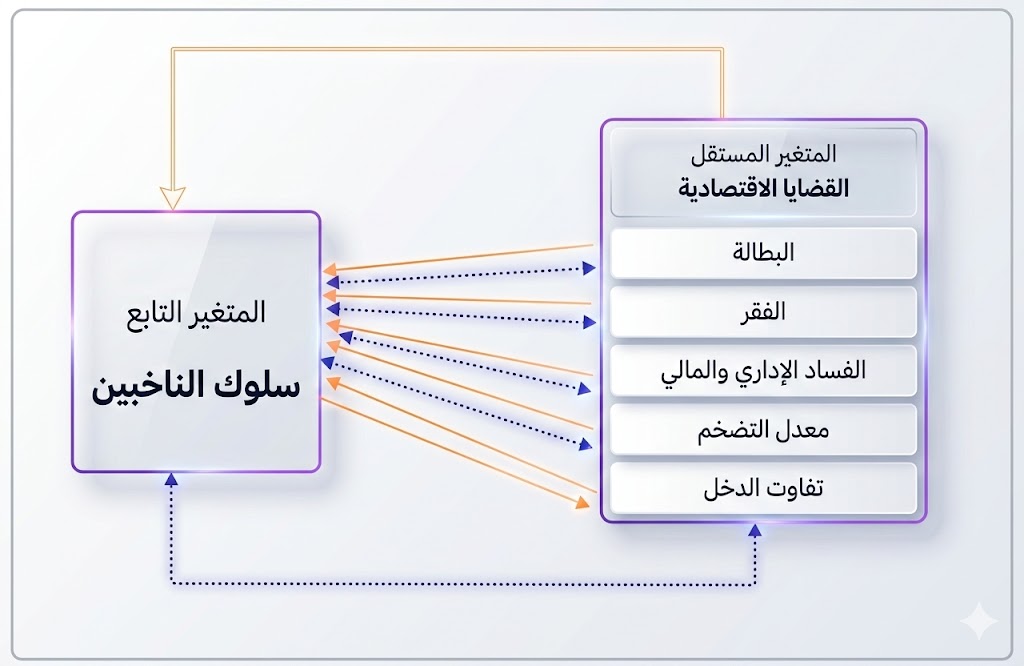
This study aims to analyze the relationship between economic issues and voter behavior in the Iraqi parliamentary elections. Economic issues, represented as the independent variable, are examined through five dimensions: unemployment, poverty, administrative and financial corruption, inflation rate, and income inequality. Voter behavior, the dependent variable, directly influences voter decision-making in the Kurdistan Region of Iraq. The study employed a descriptive both the analytical and quantitative approach, collecting and analyzing the opinions of a sample of )4,075( respondents from a total of )2,844,051( Randomly across the governorates and regions registered voters. The hypotheses were tested using statistical methods via SPSS version 24. The study reached a number of key conclusions, including a statistically significant relationship between all economic determinants (such as unemployment, poverty, corruption, inflation, and income inequality), with inflation showing the highest impact among all dimensions. This means that inflation explains more than 61% of the change in voter behavior and is the most influential economic factor in voting decisions, implying that an increase in any of these factors leads to a change in voting patterns. The study recommended a set of measures, emphasizing the need for political parties and politicians to develop specific economic strategies focused on improving citizens' living conditions. This can be achieved by implementing concrete solutions to issues such as unemployment, rising prices, and the lack of social protection services.
Downloads
References
1. حمه علي، مهدي ابوبكر،(2023)، هيمنة الثقافة السياسية الحزبية في توجيه السلوك الانتخابي في إقليم كوردستان، مجلة دراسات قانونية وسياسية، المركز الدراسات القانونية والسياسية، كلية القانون، جامعة السليمانية، اقليم كوردستان العراق، المجلد(11)، العدد(1)، ص294-257.
2. خليل، طلال حامد. (2017). نظريات السلوك الانتخابي و استقراء المؤثرات السلوكية للناخب العراقي في ضوء انتخابات 2005و 2010. مجلة العلوم القانونية والسياسية، 6(3), 129-158.
3. رفيق، هۆشمەند ،(2020)، الارهاب الاقتصادي،ط1، مطبعة كوردستان، اربيل، اقليم كوردستان-العراق.
4. زين الدين، احمد محمد،(2024)، محددات السلوك الانتخابي، مجلة القرار للبحوث العلمية المحكمة، المجلد(8)، العدد(3)، ص568-543.
5. عبدالحسن، صلاح نوري، والعبودي،علي عبدالرحيم، (2025)، الانتخابات البرلمانية العراقية لعام 2021 : دراسة في السلوك التصويتي، مجلة كلية القانون والعلوم السياسية في الجامعة العراقية، العدد(28)، ص400-375.
6. عبدالعال، هالة، (2017)، تقييم الدعاية السياسية في الانتخابات البرلمانية، دار العربي للنشر والتوزيع.
7. عبدالكاظم، ايمان جواد،(2024)، العوامل المؤثرة في سلوك الناخب العراقي بعد 2005، المجلة العراقية للعلوم السياسية، السنة الخامسة، العدد(12)، ص354-341.
8. العنبكي، طه حميد حسن،(2019)، سلوك الناخب العراقي بين ثقافة الخضوع وثقافة المشاركة، مجلة العلوم القانونية والسياسية، جامعة ديالى المجلد (6)، العدد(3)، العدد الخاص بالمؤتمر العلمي الدولي الثالث الموسوم تشكيل الوعي الإجتماعي لدى الناخب العراقي بعد تحرير نينوى ،2017/12/17-16، ص54-25.
9. قادر، زكي حسين، وصالح، شلير علي،(2023)، أثر بعض متغيرات الاقتصاد الكلي في التصويت الانتخابي لعينة من دول عربية مختارة، مجلة الغري للعلوم الاقتصادية والادارية، كلية الادارة والاقتصاد، جامعة الكوفة، المجلد(19)، العدد(3)، ص705-670.
10. قبوج، الجمعي، وهشام، عبدالكريم،(2017)، السلوك الانتخابي في المجتمع الجزائري: دراسة سوسيولوجية، المجلة الجزائرية للامن الانساني، جامعة الجزائر2، كلية العلوم الإنسانية و الإجتماعية، العدد(4)، ص80-47.
11. مبروك، خليل، (2019)، كيف أثر الوضع الاقتصادي على نتائج الانتخابات في تركيا؟، شبكة الجزيرة نيت، 2019/4/2.
12. مسمار، رامح تيسير نظمي، (2018)، دور وسائط التواصل الاجتماعي في تشكيل سلوك الانتخابي للناخبين في الضفة الغربية في الانتخابات المحلية للعام 2017 ، اطروحة الدكتوراه منشورة، كلية دراسات العليا، جامعة النجاح الوطنية في نابلس، فسطين.
13. المفوضية العليا المستقلة للانتخابات-العراق، انتخابات مجلس النواب العراقي 2021- النتائج النهائية،2025/11/1
14. منار، محمد باسك،(2021)، سمات السلوك الانتخابي للطبقة الوسطى بالمغرب: دراسة ميدانية، مركز تكامل للدراسات والابحاث، مغرب.
15. يوسف، محمد عبدالكريم، (2025)، لعوامل الاقتصادية التي تحدد نتائج الانتخابات، مجلة الحوار المتمدن، 2025/1/11.
16. Abdullah, S., & Gray, T. (2022). Political constraints on economic diversification in the Kurdistan Region of Iraq. Energy Policy, 171, 113274.
17. Blyth, M. (2002). Great Transformations: Economic Ideas and Institutional Change in the Twentieth Century. Cambridge University Press.
18. Cronbach, L. J. (1951).Coefficient alpha and the internal structure of tests. psychometrika, 16(3), 297-334.
19. Goodman, S., & Kramer, G. H. (1975). Comment on Arcelus and Meltzer, the effect of aggregate economic conditions on congressional elections. American Political Science Review, 69(4), 1255-1265.
20. Kama, Ö., Aksoy, T., & Taştan, H. (2022). Economic Adversity and Voter Turnout: Evidence from Turkish Parliamentary Elections. Social Indicators Research, 163(2), 799-821.
21. MacKuen, M. B., Erikson, R. S., & Stimson, J. A. (1992). "Peasants´-or-Party Animals? The American Electorate and the Politics of Economic Expectations." American Political Science Review, 86(3), 586-597.
22. Maghdid, R. S., Kareem, S. M., Salih Hama, Y., Waris, M., & Naveed, R. T. (2024). RETRACTED: Moderating role of political stability and economic policy uncertainty between country governance practice and stock market performance. A comparative analysis of Pakistan and Kurdistan Region of Iraq. Plos one, 19(4), e0301698.
23. Mahoney, P. L. (2022). The effects of economic globalization on voter turnout.
24. Rodrik, D. (2011). The globalization paradox: Democracy and the future of the world economy. WW Norton & Company.
25. Yamao, D., & Hamanaka, S. (2021). Political mobilization and its impact on voter turnout: A survey experiment in Iraq. Asian Journal of Comparative Politics, 6(4), 421-440.
Downloads
Published
How to Cite
Issue
Section
License
Copyright (c) 2026 Hoshmand Rafiq Ibrahim

This work is licensed under a Creative Commons Attribution-NonCommercial-NoDerivatives 4.0 International License.
Authors retain the copyright of their papers without restrictions.