The Effect of Servant Leadership on Promoting Employees’ Psychological Resilience
An applied study at Al-Rifa’i Municipal Directorate
DOI:
https://doi.org/10.71207/ijas.v22i87.5613Keywords:
Servant leadership, psychological resilience, emotional healing, empowermentAbstract
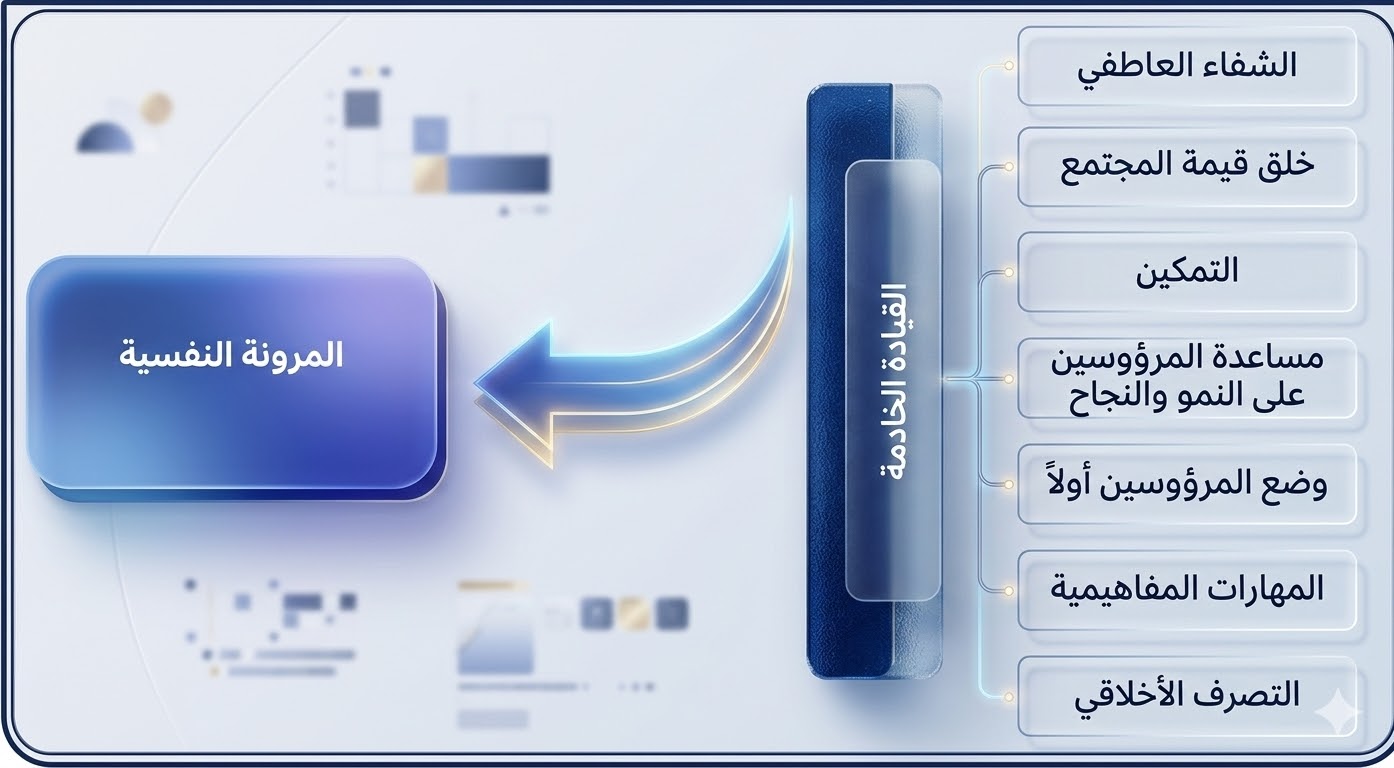
The study aimed to investigate the relationship between servant leadership and psychological resilience among employees at Al-Rifaie Municipality in Thi-Qar, using a quantitative descriptive approach with a sample of 256 employees. The results indicated a strong positive effect of servant leadership dimensions (emotional healing, creating value for the community, empowerment, assisting subordinates in growth and success, putting subordinates first, ethical behavior, and conceptual skills) on psychological resilience dimensions (emotional regulation, cognitive flexibility, social support, sense of meaning and purpose, and self-control and personal efficacy), with varying strengths of influence. It is concluded that servant leadership enhances psychological resilience by fostering a supportive work environment based on trust, capacity building, and a sense of meaning and competence, enabling employees to adapt positively to workplace stressors and professional changes.
Downloads
References
1. Al-Haddad, S., & Kotnour, T. (2015). Integrating the Organizational Change Literature: A Model for Successful Change. Journal of Organizational Change Management, 28, 234-262.
2. Avolio, B.J. and Gardner, W.L. (2005) Authentic Leadership Development: Getting to the Root of Positive Forms of Leadership. The Leadership Quarterly, 16, 315-338.
3. Brown, M. E., & Treviõo, L. K. (2006). Ethical Leadership: A Review and Future Directions. The Leadership Quarterly, 17, 595-616.
4. Eva, N., Robin, M., Sendjaya, S., van Dierendonck, D., & Liden, R. C. (2019). Servant leadership: A systematic review and call for future research. The Leadership Quarterly, 30(1), 111-132.
5. Greenleaf, R. K. (1977). Servant Leadership: A Journey into the Nature of Legitimate Power and Greatness. Paulist Press.
6. Hoch, J. E., Bommer, W. H., Dulebohn, J. H., & Wu, D. (2018). Do ethical, authentic, and servant leadership explain variance above and beyond transformational leadership? A meta-analysis. Journal of Management, 44(2), 501-529.
7. Laub, J. A. (1999). Assessing the servant organization: Development of the servant organizational leadership assessment (SOLA) instrument. [Doctoral dissertation, Florida Atlantic University].
8. Liden, R. C., Wayne, S. J., Zhao, H., & Henderson, D. (2008). Servant leadership: Development of a multidimensional measure and multi-level assessment. The Leadership Quarterly, 19(2), 161-177.
9. Mayer, D. M., Kuenzi, M., Greenbaum, R., Bardes, M., & Salvador, R. B. (2012). How low does ethical leadership flow? Test of a trickle-down model. Organizational Behavior and Human Decision Processes, 108(1), 1-13.
10. Neider, L. L., & Schriesheim, C. A. (2011). The authentic leadership inventory (ALI): Development and empirical tests. The Leadership Quarterly, 22(6), 1146-1164.
11. Newman, A., Schwarz, G., Cooper, B., & Sendjaya, S. (2017). How servant leadership influences organizational citizenship behavior: The roles of LMX, empowerment, and proactive personality. Journal of Business Ethics, 145(1), 49–62.
12. Owens, B. P., & Hekman, D. R. (2012). Modeling how to grow: An inductive examination of humble leader behaviors, contingencies, and outcomes. Academy of Management Journal, 55(4), 787–818.
13. Sousa, M., & van Dierendonck, D. (2017). Servant leadership and the effect of the interaction between humility, action, and hierarchical power on follower engagement. Journal of Business Ethics, 141, 13–25.
14. Spears, L. C. (2010). Character and servant leadership: Ten characteristics of effective, caring leaders. The Journal of Virtues & Leadership, 1(1), 25–30.
15. van Dierendonck, D. (2011). Servant leadership: A review and synthesis. Journal of Management, 37(4), 1228–1261.
16. Alsubaie, M. M., Stain, H. J., Webster, L. A., & Wadman, R. (2019). The role of spirituality in the psychological resilience of Saudi Arabian women. International Journal of Mental Health and Addiction, 17, 683-695.
17. Bandura, A. (1997). Self-efficacy: The exercise of control. Freeman.
18. Baumeister, R. F., Heatherton, T. F., & Tice, D. M. (1994). Losing control: How and why people fail at self-regulation. Academic Press.
19. Bonanno, G. A. (2004). Loss, trauma, and human resilience: Have we underestimated the human capacity to thrive after extremely aversive events? American Psychologist, 59(1), 20–28.
20. Cohen, S., & Wills, T. A. (1985). Stress, social support, and the buffering hypothesis. Psychological Bulletin, 98(2), 310-357.
21. Connor, K. M., & Davidson, J. R. (2003). Development of a new resilience scale: The Connor-Davidson Resilience Scale (CD-RISC). Depression and Anxiety, 18(2), 76-82.
22. Dennis, J. P., & Vander Wal, J. S. (2010). The cognitive flexibility inventory: Instrument development and estimates of reliability and validity. Cognitive Therapy and Research, 34(3), 241-253.
23. Fletcher, D., & Sarkar, M. (2013). Psychological resilience: A review and critique of definitions, concepts, and theory. European Psychologist, 18(1), 12-23.
24. Frankl, V. E. (1963). Man's search for meaning. Beacon Press.
25. Gross, J. J. (2002). Emotion regulation: Affective, cognitive, and social consequences. Psychophysiology, 39(3), 281-291.
26. Gross, J. J. (2014). Emotion regulation: Conceptual and empirical foundations. In J. J. Gross (Ed.), Handbook of emotion regulation (pp. 3-20). Guilford Press.
27. House, J. S. (1981). Work stress and social support. Addison-Wesley.
28. Jackson, D., Firtko, A., & Edenborough, M. (2007). Personal resilience as a strategy for surviving and thriving in the face of workplace adversity: A literature review. Journal of Advanced Nursing, 60(1), 1-9.
29. Jackson, D., Firtko, A., & Edenborough, M. (2007). Personal resilience as a strategy for surviving and thriving in the face of workplace adversity: A literature review. Journal of Advanced Nursing, 60(1), 1-9.
30. Luthans, F., Youssef, C. M., & Avolio, B. J. (2007). Psychological capital: Developing the human competitive edge. Oxford University Press.
31. Martin, M. M., & Rubin, R. B. (1995). A new measure of cognitive flexibility. Psychological Reports, 76(2), 623-626.
32. Ryff, C. D., & Singer, B. H. (2008). Know thyself and become what you are: A eudaimonic approach to psychological well-being. Journal of Happiness Studies, 9(1), 13-39.
33. Schunk, D. H., & DiBenedetto, M. K. (2020). Motivation and social-emotional learning: Theory, research, and practice. Contemporary Educational Psychology, 60, 101830.
34. Smith, B. W., Dalen, J., Wiggins, K., Tooley, E., Christopher, P., & Bernard, J. (2008). The brief resilience scale: Assessing the ability to bounce back. International Journal of Behavioral Medicine, 15(3), 194-200.
35. Southwick, S. M., Bonanno, G. A., Masten, A. S., Panter-Brick, C., & Yehuda, R. (2014). Resilience definitions, theory, and challenges: Interdisciplinary perspectives. European Journal of Psychotraumatology, 5(1), 25338.
36. Steger, M. F., Frazier, P., Oishi, S., & Kaler, M. (2006). The meaning in life questionnaire: Assessing the presence of and search for meaning in life. Journal of Counseling Psychology, 53(1), 80-93.
37. Thoits, P. A. (2011). Mechanisms linking social ties and support to physical and mental health. Journal of Health and Social Behavior, 52(2), 145-161.
38. Tugade, M. M., & Fredrickson, B. L. (2004). Resilient individuals use positive emotions to bounce back from negative emotional experiences. Journal of Personality and Social Psychology, 86(2), 320-333.
39. Ungar, M. (2011). The social ecology of resilience: Addressing contextual and cultural ambiguity of a nascent construct. American Journal of Orthopsychiatry, 81(1), 1-17.
40. Vanderbilt-Adriance, E., & Shaw, D. S. (2008). Protective factors and the development of resilience in the context of neighborhood disadvantage. Journal of Abnormal Child Psychology, 36(6), 887-901.
41. Wrzesniewski, A., McCauley, C., Rozin, P., & Schwartz, B. (2003). Jobs, careers, and callings: People's relations to their work. Journal of Research in Personality, 31(1), 21-33.
42. Sekaran, U., & Bougie, R. (2020). Research Methods for Business: A Skill-Building Approach (7th ed.). Wiley.
43. Peng, C., Liang, Y., Yuan, G., Xie, M., Mao, Y., Harmat, L., & Bonaiuto, F. (2023). How servant leadership predicts employee resilience in public organizations: A social identity perspective. Current Psychology, 42, 31405–31420.
44. Wilkinson, Aaron D. and Rennaker, Mark (2022) "The Relationship Between Servant-Leadership and Employee Resilience," International Journal of Servant-Leadership: Vol. 16, Article 14.
45. Wiroko, E. P. (2021). The Role of Servant Leadership and Resilience in Predicting Work Engagement. Journal of Resilient Economies, 1(1).
46. Krejcie, R. V., & Morgan, D. W. (1970). Determining sample size for research activities. Educational and Psychological Measurement, 30(3), 607–610.
Downloads
Published
How to Cite
Issue
Section
License
Copyright (c) 2026 Amal Jaber Fzaea

This work is licensed under a Creative Commons Attribution-NonCommercial-NoDerivatives 4.0 International License.
Authors retain the copyright of their papers without restrictions.