Enlightened leadership and its impact on workplace harmony
An analytical study of the opinions of a sample of healthcare staff working in some private hospitals
DOI:
https://doi.org/10.71207/ijas.v22i87.5767Keywords:
Enlightened Leadership, Workplace Harmony.Abstract
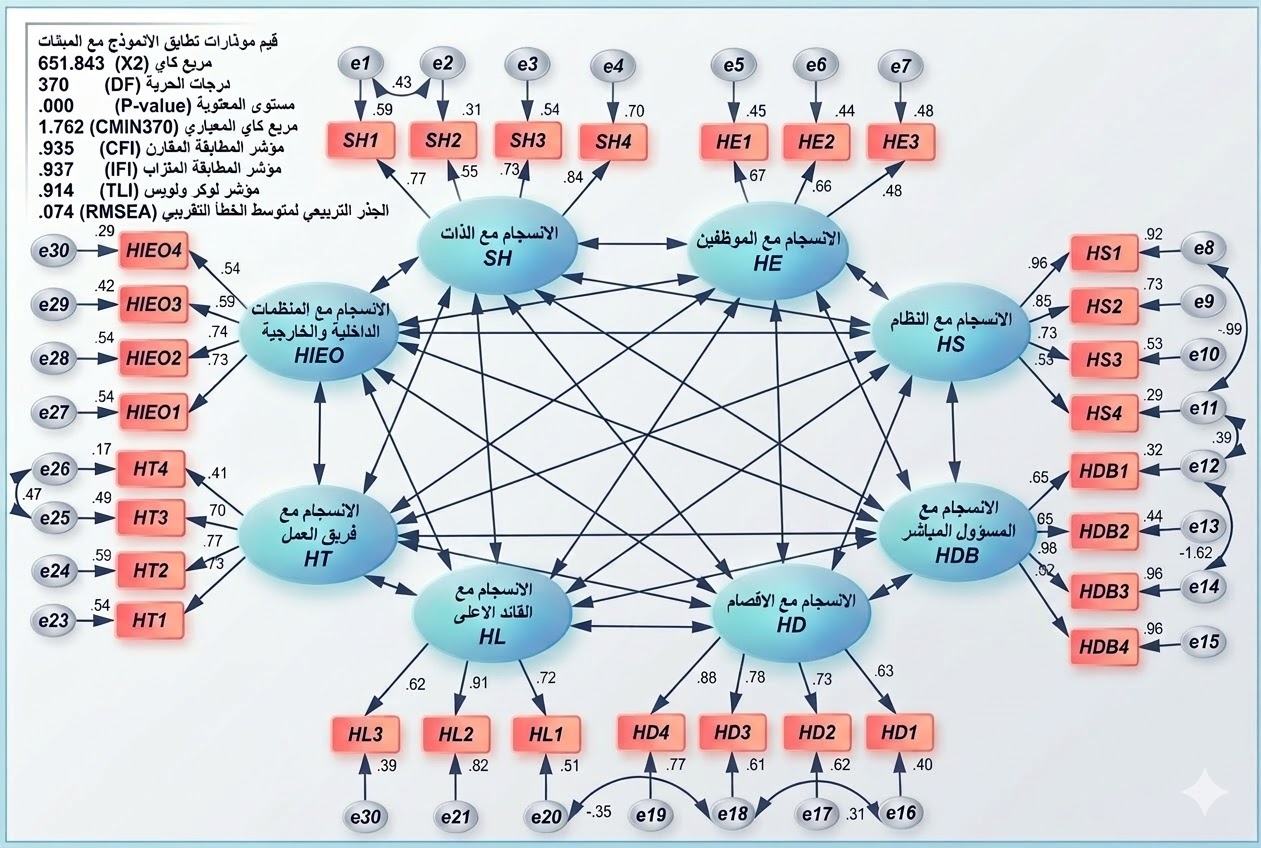
The study aimed to determine the level of impact of enlightened leadership on enhancing workplace harmony through an analytical survey of the opinions of a sample of healthcare staff working in some private hospitals. Enlightened leadership was measured through six dimensions: role model, developer, servant, visionary, communicator, and change agent. Workplace harmony was measured through several dimensions related to the relationships and interactions among employees within the organization. The study population consisted of healthcare staff working in the hospitals under study, and a random sample of (173) doctors and nurses was selected. A questionnaire was used as the main tool for data collection. The data were analyzed using several statistical methods, including the normal distribution test, confirmatory factor analysis, descriptive statistics, Pearson correlation analysis, and structural equation modeling to test the research hypotheses. The results revealed significant correlation and effect relationships between enlightened leadership and workplace harmony, indicating its role in promoting a more harmonious and cooperative work environment.
Downloads
References
1. الفتلاوي, ميثاق هاتف, الحکيم, ليث علی یوسف, القاضي, & نعيم سلامة. (2018). رأس المال الرمزي وانعکاسه في القيادة المستنيـرة: دراسة حالة في مديـرية تـربية قضاء المسيب. المجلة العربية للإدارة, 38(1), 109-138 .
2. احمد محمود هادي سعيد، نبيلة عبيد محمد جعفر السقاف، وعصام محسن ناصر قاسم. (2024). أثر سلوكيات القيادة المستنيرة في التنمية المستدامة: دراسة حالة للهيئة اليمنية للمواصفات والمقاييس وضبط الجودة – م/عدن. Journal of Social Studies، 30(5)، 47–74.
3. العاني، آلاء عبدالواجد عبدالجبار، الهاشمي، شيماء محمد صالح، والحمادي، أحمد خالد خليل. (2025). القيادة المتناقضة ودورها في تحقيق الانسجام في مكان العمل دراسة استطلاعية للأفراد العاملين في رئاسة جامعة الموصل. مجلة اقتصاديات الأعمال للبحوث التطبيقية، 7(1)، 1212–1232. https://doi.org/10.37940/BEJAR.2025.7.2.60
4. فريدون، درون، & عبدالله. (2019). دور سلوكيات القيادة المستنيرة في الإدارة الفعالة: تحليل لأزمات تنظيمية في عينة من العاملين في رئاسة جامعة السليمانية. المجلة العلمية لجامعة جيهان السليمانية، 3(1)
5. Akinbode, A. I., & Al Shuhumi, S. R. A. (2018). Change management process and leadership styles. PEOPLE: International Journal of Social Sciences, 4(2), 609-618.
6. Agabe, N. A. (2024). Workplace discipline and industrial harmony of construction companies in Yenagoa, Bayelsa State. BW Academic Journal, 24, 24–24
7. Al-Daamee, W. A. J., & Almowail, T. F. A. (2021). The role of visionary leadership in reducing the financial failure of banks: An exploratory study in a sample of Iraqi commercial banks. Turkish Journal of Computer and Mathematics Education, 12(7), 3250-3263.
8. Al‑Hadrawi, R., & Jabr, M. (2024). The role of paradoxical leadership behaviors in reducing strategic ambiguity: An analytical study of the opinions of a sample of workers at the Najaf Teaching Hospital. Journal of Kufa Studies Center, 1(72(B)), 355–378.
9. Ali, M., & Ebrahimi, M. (2020). The impact of enlightened leadership dimensions on workplace harmony. International Journal of Organizational Studies, 9(1), 35–45
10. Alkass, S. (2021). Enlightened leadership and its impact on organizational performance. Journal of Business Research, 17(2), 142–156.
11. Andacao, A. A. (2015). Visionary Leadership, Team Building Competence, and Conflict Resolution Skills of School Administrators: Structural Model on Organizational Efficiency. IAMURE International Journal of Education, 10(1).
12. Andacao, A. A. (2017). Enlightened leadership of school administrators and organizational Commitment of state college employees. IAMURE, 21.
13. Bell، D. A.، & Mo، Y. (2014). Harmony in the world 2013: The ideal and the reality. Social Indicators Research، 118، 797-818.
14. Bob-Manuel، I. V.، Georgewill، I. A.، & Tamunomiebi، M. D. (2024). Self-awareness and Workplace Harmony of Printing Companies in Port Harcourt، Nigeria.
15. Burton, T. T. (2012). The generations of improvement. Industrial Engineer, 44(8), 46-50.
16. Caldwell, C., & Anderson, V. (2019). Trust, trustworthiness, and stewardship: A transformative approach. Nova Science Publishers, Incorporated.
17. Chin، T. (2014). Harmony as means to enhance affective commitment in a Chinese organization. Cross Cultural Management، 21(3)، 326-344.
18. Chuanlei، L.، & Guomin، L. (2018). Research On Mental Health Status And The Relationship Between Spiritual Belief And Self–Harmony. Social Values & Society (SVS)، 1(1)، 5-10.
19. Cogswell, J. E., Marshall, C. J., & Smith, L. D. (2023). The Makings of a Servant Leader: The Role of Personality and Character in Effective Servant Leadership. In The Palgrave Handbook of Servant Leadership (pp. 43-68). Cham: Springer International Publishing.
20. Coughlin, D. (2005). Inspired leadership: 52 weeks to becoming a better leader. AMACOM.
21. Culbert, S. A., & Ullmen, J. B. (2001). Don’t Kill the Bosses!: Escaping the Hierarchy Trap. Berrett‑Koehler Publishers.
22. Dahron, D. (2019). The behavior of enlightened leadership and its role in the effective management of organizational crises. An analytical study of the opinions of a sample of employees in the presidency of the University of SulaimaniA, master's degree, College of Administration and Economics, University of Sulaymaniyah.
23. Dewydar، W. M. E. N. S. (2015). The optimum relationship between managers and employees. International Journal of business and social Science، 6(8)، 135-141.
24. Fattah, N. A. (2024). The role of enlightened leadership in change management organizational: An exploratory study of the opinions of a sample of workers in the nineveh center electricity distribution directorate. Muthanna Journal of Administrative and Economic Sciences, 14(1).
25. Gabarro، J. J.، & Kotter، J. P. (2008). Managing your boss. Harvard Business Review.
26. Gerwing, C. (2016). Meaning of change agents within organizational change. Journal of Applied Leadership and Management, 4, 21-40.
27. Girigiri، B. W.، & Badom، P. M. (2021). Industrial harmony and work discontent: Employer and employee relations perspective. International Journal of Research Publications، 80(1)، 209-219.
28. Habeeb، M. O. Y.، & Kazeem، A. O. (2018). Organization conflict and industrial harmony: A synthesis of literature. Organization، 10(11).
29. Houghton, J. D., Neck, C. P., & Manz, C. C. (2016). Self-leadership and shared leadership in teams: Examining multilevel effects. Journal of Managerial Psychology, 31(4), 918–932. Human Resource Management Review, 12(2), 193–214.
30. Ionescu, V. C., & Bolcaş, C. (2019). Leadership and organizational development. Revista de Management Comparat International, 20(5), 557-564.
31. Jiménez-Estévez, P., Yáñez-Araque, B., Ruiz-Palomino, P., & Gutiérrez-Broncano, S. (2023). Personal growth or servant leader: What do hotel employees need most to be affectively well amidst the turbulent COVID-19 times?. Technological Forecasting and Social Change, 190, 122410.
32. Kwan، V. S.، Bond، M. H.، & Singelis، T. M. (1997). Pancultural explanations for life satisfaction: adding relationship harmony to self-esteem. Journal of personality and social psychology، 73(5)، 1038
33. Lambe, J. (2011). Pre-service education and attitudes towards inclusion: The role of the teacher educator within a permeated teaching model. International Journal of Inclusive Education, 15(9), 975-999.
34. Lantu, D. C. (2015). Leadership competencies for organizational harmony. Journal of Management Development, 34(5), 593–606
35. Li، C. (2006). The Confucian ideal of harmony. Philosophy East and West، 583-603.
36. Liu, C., Li, G., Han, Y., & Wu, G. (2018). Research on mental health status and the relationship between spiritual belief and self‑harmony. Science Heritage Journal (GWS), 2(2), 16–20.
37. Lockwood, P., Jordan, C. H., & Kunda, Z. (2002). Motivation by positive or negative role models: regulatory focus determines who will best inspire us. Journal of personality and social psychology, 83(4), 854.
38. Mahdi, D. R., & Mohammed, A. J. (2024). The effect of enlightened leadership practices on organizational sustainability: An Analytical research in the colleges of the University of Baghdad. Journal of Economics and Administrative Sciences, 30(142), 234-249.
39. Manuel, P. J. E., Mempin, J. R., & Alde, M. A. C. (2024). Unveiling the Strategic Planning of Teachers, Performance Task Outcome and Learning Style of Students. International Journal of Research and Innovation in Social Science, 8(1), 565-581.
40. Mensah, E. A. (2020). The disharmony in harmony: Experiences of female leaders in higher education. In INTED2020 Proceedings (pp. 589–596).
41. Odunukwe، I. E.، Anah، M. O.، & Ezeh، M. U. (2023). Workplace harmony and organizational productivity of selected deposit money banks in Anambra state. Global Online Journal of Academic Research (GOJAR)، 2(1).
42. Okpu، T.، & Kpakol، A. G. (2015). Managing employee trust perceptions for sustained workplace harmony in the Nigerian banking industry. International Journal of Managerial Studies and Research، 3(5)، 65-73.
43. Onyeizugbe، C. U.، Aghara، V.، Olohi، E. S.، & Chidiogo، A. P. (2018). Industrial harmony and employee performance in food and beverage firms in Anambra State of Nigeria. International journal of managerial studies and research (IJMSR)، 6(6)، 22-35.
44. Ozoekwe، C.، & Konya، K. T. (2021). Leaders’ Emotional Intelligence and Workplace Harmony in Manufacturing Companies in Port Harcourt، Rivers State، Nigeria. Management Sciences.
45. Ozoekwe، C.، & Konya، K. T. (2021). Leaders’ Emotional Intelligence and Workplace Harmony in Manufacturing Companies in Port Harcourt، Rivers State، Nigeria. Management Sciences.
46. Reave, L. (2005). Spiritual values and practices related to leadership effectiveness. The Leadership Quarterly, 16(5), 655–687.
47. Rogainis، J. (1991، September). Finding harmony in systems development and user services. In Proceedings of the 19th annual ACM SIGUCCS conference on User services (pp. 325-331).
48. Santín، D.، & Tejada، J. (2025). Is it worth it? Using DEA to analyze the efficiency gains and costs of merging university departments: a case study of the Complutense University of Madrid. International Transactions in Operational Research، 32(5)، 2593-2619.
49. Sealy, R., & Singh, V. (2010). The importance of role models and demographic context for senior women’s work identity development. International Journal of Management Reviews, 12(3), 284–300.
50. Strang, S. E. (2006). Big Five personality and leadership developmental levels as predictors of leader performance (Master’s thesis). University of Georgia.
51. Tambari, J. C. (2020). Organizational trust and workplace harmony: Evidence from White Diamond Salt Limited and National Salt Company of Nigeria, Port Harcourt. The Strategic Journal of Business and Change Management.
52. Utomo, W. A., Udin, U. D. I. N., & Haryono, S. (2022). Visionary leadership and employee quality in the public service sector. International Journal of Applied Economics, Finance and Accounting, 12(2), 31-37.
53. Welbeck, B. A., & Thelma, C. C. (2025). The Impact of Employee Relations and Workplace Harmony on Productivity: A Case Study of the Government Hospitals Pharmacists’ Association, Ghana. Advances in Research, 26(5), 385-398.
54. Xu, F., Xu, B., Anderson, V., & Caldwell, C. (2019). Humility as enlightened leadership: A Chinese perspective. Journal of Management Development, 38(3), 158-174.
55. Zwain, A. A. A. (2022). Emerging leaders development and its effect on psychological empowerment. Journal of the Islamic University College, 66, 755–783.
Downloads
Published
How to Cite
Issue
Section
License
Copyright (c) 2026 Fatima Amer Hamoud Al-Karawi , Hussein Hurajah Al-Hasnawi

This work is licensed under a Creative Commons Attribution-NonCommercial-NoDerivatives 4.0 International License.
Authors retain the copyright of their papers without restrictions.