The Role of Natural Resources in Achieving Economic Growth
(A Comparative Study between the Japanese and Saudi Economies) for the Period 2000-2023
DOI:
https://doi.org/10.71207/ijas.v22i87.5804Keywords:
The resource curse, innovation, human capital, economic growthAbstract
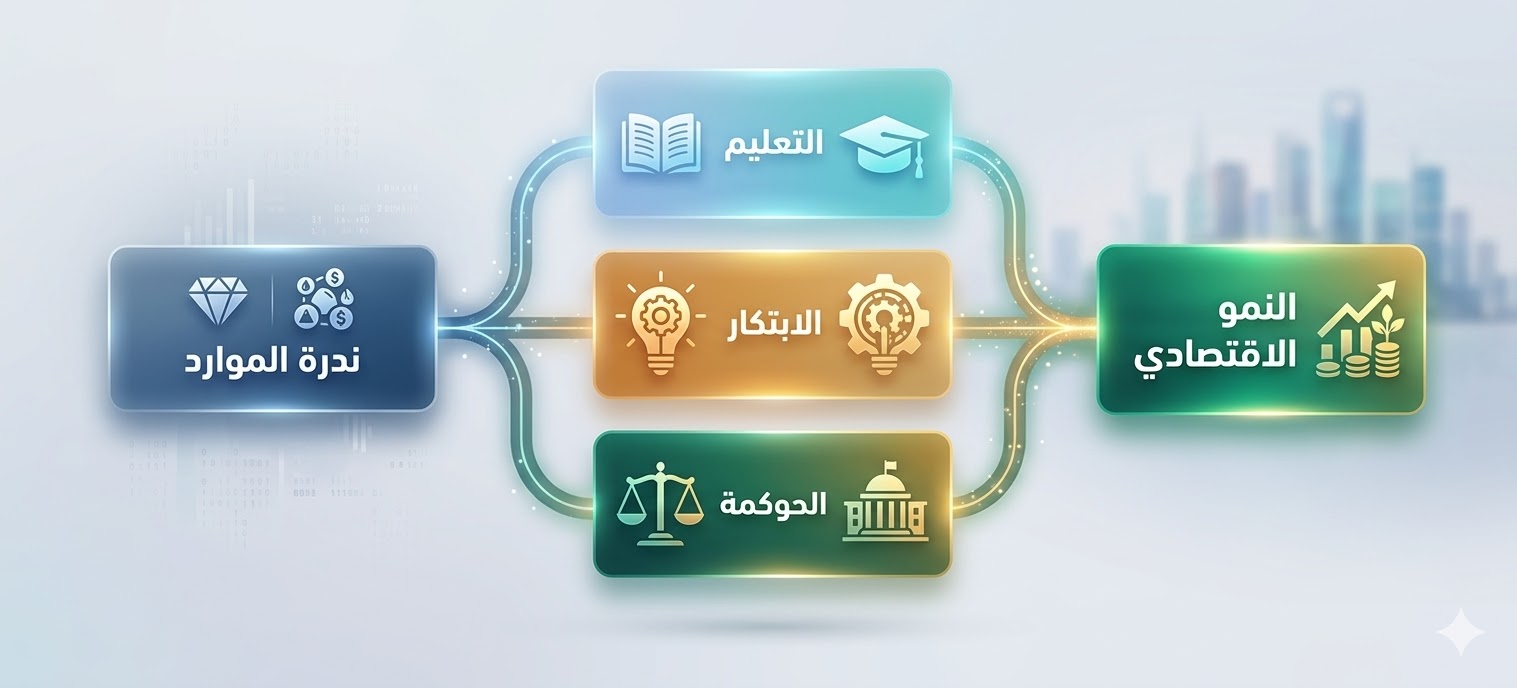
This study aims to analyze the relationship between natural resource scarcity and economic growth, using Japan as a case study and comparing it with a resource-rich country such as Saudi Arabia over the period 2000–2023. The research is based on the premise that the lack of natural resources does not necessarily hinder economic growth; rather, it can serve as a stimulus for innovation, economic diversification, and technological advancement when accompanied by effective policies in education, research, and trade openness. Data were drawn from the World Bank (WDI) and the OECD, covering key variables including real GDP growth, natural resource dependency, public expenditure on education, R&D spending, and trade openness. The findings reveal that Japan has successfully transformed its resource scarcity into a competitive advantage by investing heavily in human capital and technological innovation. Conversely, Saudi Arabia shows a pattern of high dependency on oil revenues, with growth fluctuations linked to global energy price cycles. The study concludes that effective management of scarcity can promote sustainable growth, whereas poorly managed resource abundance may result in structural imbalances, commonly described as the “resource curse.
Downloads
References
1. Auty, Richard. 1993. Sustaining Development in Mineral Economies. London .
2. Cust, J., & Mihalyi, D. 2017. The presource curse. Policy Research Working Paper 8157. s.l. : World Bank., 2017.
3. Frankel, J. A. 2010. The natural resource curse: A survey. NBER Working Paper No. 15836. 2010.
4. Gildas Dohba Dinga a, b, Ndam Mama a,c,∗, Elvis D Achuo b,d. 2024. Resource abundance: Blessing or curse? Comparative analyses of point and diffuse resources. Heliyon. 2024, Volume 10, Issue 3.
5. Matallah, Siham. 2020. Economic diversification in MENA oil exporters: Understanding the role of governance. https://doi.org/10.1016/j.resourpol.2020.101602
6. Mehlum, H., Moene, K., & Torvik, R. 2006. Institutions and the Resource Curse. The Economic Journal,. 2006, 116(508).
7. Narh, John. 2023. The resource curse and the role of institutions revisited. Environment, Development and. 2023, Volume 27.
8. OECD. https://gpseducation.oecd.org/CountryProfile?primaryCountry=JPN&topic=EO&treshold=10&utm.com. [Online]
9. Organisation for Economic Co-operation and Development. https://www.oecd.org/en/publications/oecd-economic-outlook-volume-2024-issue-2_d8814e8b-en.html. [Online]
10. Randall Jones. 2017. https://oecdecoscope.blog/2017/04/25/japan-needs-policies-to-boost-productivity-for-inclusive-growth/. Japan needs policies to boost productivity for inclusive growth. [Online] Head of Japan Desk, OECD Economics Department, April 15, 2017.
11. Ross, Michael L. 2015. What Have We Learned about the Resource Curse? Annual Review of Political Science . 2015, Volume 18, 2015.
12. sachs, J. D., & Warner, A. 2001. The Curse of Natural Resources. European Economic Review, . 2001, 45(4-6).
13. Sen, Antonio Savoia and Kunal. 2011. The Political Economy of the Resource Curse: A Development Perspective. Annual Review of Resource Economics. 2011, Volume 13.
14. Tomas Havraneka, b Roman Horvathb .Ayaz Zeynalovb. 2016. Natural Resources and Economic Growth: A Meta-Analysis. Czech Republic : bInstitute of Economic Studies, Faculty of Social Sciences, Charles University in Pragu, 2016.
15. Torvik, R. 2009. Why do some resource-abundant countries succeed while others do not? Oxford Review of Economic Policy. 2009. Vol. 25(2).
16. Tsur, Y., & Zemel, A. 2014. Dynamic and stochastic analysis of scarcity, growth, and innovation. Journal of Environmental Economics and Management. 2014, 68(2),.
17. Usman, Zainab. 2022. Economic Diversification in Nigeria: The Politics of Building a Post-Oil Economy. https://hdl.handle.net/10419/281244, 2022.
18. wipo. https://www.wipo.int/en/ipfactsandfigures/patents?utm.com=. [Online]
19. World Bank Group. https://data.worldbank.org/indicator/NY.GDP.MKTP.KD.ZG?locations=JP. [Online]
Downloads
Published
How to Cite
Issue
Section
License
Copyright (c) 2026 ابتهال ناهي شاكر

This work is licensed under a Creative Commons Attribution-NonCommercial-NoDerivatives 4.0 International License.
Authors retain the copyright of their papers without restrictions.