Measuring the Cultural Impact of Sustainable Marketing on Branding
An Analytical Survey of the Opinions of a Sample of Physicians, Administrators, and Technicians Working in Private Hospitals in the Center of Maysan Governorate
DOI:
https://doi.org/10.71207/ijas.v22i87.5689Keywords:
The cultural dimension of sustainable marketing, BrandingAbstract
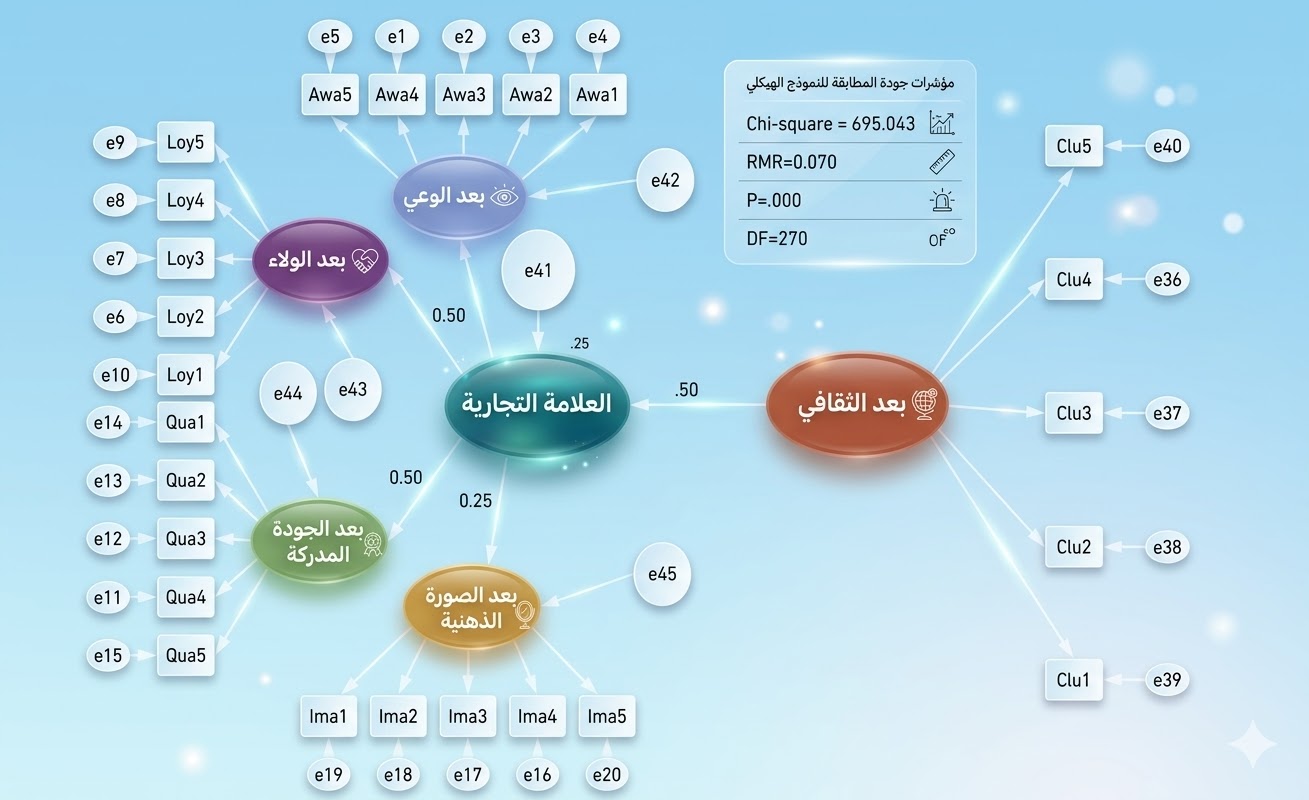
This research aimed to measure the impact of the cultural dimension of sustainable marketing on branding by targeting private hospitals in the center of Maysan Governorate. These hospitals have limited attention to considering cultural aspects in their marketing practices, resulting in weak brand strength. A sample of 136 employees was selected, comprising doctors, administrators, and technicians. The study adopted a descriptive-analytical approach, collecting data using a questionnaire. Data was analyzed using the statistical tools available in SPSS software, namely means and standard deviations. The results showed a statistically significant positive correlation between the cultural dimension of sustainable marketing and branding, specifically in its dimensions of brand awareness, brand loyalty, brand image, and perceived quality. The research's significance lies in highlighting the active role of the cultural dimension in strengthening hospital brands, thereby contributing to improved patient loyalty. The research recommends the necessity of emphasizing the consideration of values, customs, traditions, and privacy in the provision of medical services, and establishing training programs to raise the level of cultural awareness. Among the employees, which contributes to strengthening its brand and achieving a competitive advantage.
Downloads
References
1. ندوش،ام البنين جبار.(2025).تأثير إدارة سلسلة التجهيز الرشيقة في تعزيز الابداع التسويقي الدور المعدل لبناء العلامة التجارية:دراسة ميدانية في شركة الاتحاد للصناعات الغذائية المحدودة (أطروحة دكتوراه غير منشورة)، جامعة كربلاء ، كلية الإدارة والاقتصاد ،العراق ،كربلاء .
2. Akolkar, A. H., Neeraj, S., Vardhan,S., Upparu, N. R., & Khan, E. (2024). Cultural differences affecting advertising. International Research Journal of Economics and Management Studies IRJEMS, 3(10).
3. Adiwijaya, M., McGuinness, E., Cary, J. C., & Herjanto, H. (2021). The centrality of brand awareness. Petra International Journal of Business Studies, 4(2), 109-121.
4. Ariyanto, R., & Kustini, K. (2021). Employer branding and employee value proposition: The key success of startup companies in attracting potential employee candidates. Annals of Human Resource Management Research, 1(2), 113-125.
5. Azzahra, N., Febrian, A., Pratama, D., Na’im, A., & Mawardi, M. (2023). The Effect of Perceived Quality, Brand Awareness, and Brand Association in Building Brand Loyalty Among Young Consumers. In ICEBE 2023: Proceedings of the 6th International Conference of Economics, Business, and Entrepreneurship, ICEBE 2023, 13-14 September 2023, Bandar Lampung, Indonesia (p. 183). European Alliance for Innovation.
6. Briciu, V. A., & Briciu, A. (2016). A brief history of brands and the evolution of place branding. Bulletin of the Transilvania University of Braşov. Series VII: Social Sciences• Law, 137-142.
7. Chaokromthong, K., & Sintao, N. (2021). Sample size estimation using Yamane and Cochran and Krejcie and Morgan and green formulas and Cohen statistical power analysis by G* Power and comparisions. Apheit international journal of interdisciplinary social sciences and technology, 10(2), 76-86
8. Coelho, F. J., Bairrada, C. M., & de Matos Coelho, A. F. (2020). Functional brand qualities and perceived value: The mediating role of brand experience and brand personality. Psychology & Marketing, 37(1), 41-55.
9. Chen, A. H., & Wu, R. Y. (2022). Mediating effect of brand image and satisfaction on loyalty through experiential marketing: A case study of a sugar heritage destination. Sustainability,14(12), 7122.
10. Dimas-Skari, A. (2019). Supplier selection strategy of a business organization. Texila International Journal of Management, Special Edition, Article
11. Fadjar, adfiyanti & barizah, nurul & rahmah, mas. (2023). Expanding horizons: non-traditional trademarks types and registration practices in indonesia.Tadulako law review. 8. 1-1
12. Fifld,A.(2009). Discovering Statistics Using SPSS (3 rd. ed.). SAGE Publications.
13. Gong, Y., Xiao, J., Tang, X., & Li, J. (2023). How sustainable marketing influences the customer engagement and sustainable purchase intention? The moderating role of corporate social responsibility. Frontiers in Psychology, 14, 1128686.
14. Isnubroto, R., & Ridanasti, E. (2025). The Effect of Brand Image, Brand Experience Through Brand Trust on Purchase Intention Brand Bwbyaz on Instagram. MEC-J (Management and Economics Journal), 9(2), 177-194.
15. Järvelä, M. (2023). Dimensions of cultural sustainability—Local adaptation, adaptive capacity and social resilience. Frontiers in Political Science, 5, 1285602.
16. Kotller, P., & Keller, K. L. (2012). Marketing management (14th ed.). New York, NY: Prentice Hall.
17. Kedar, m. S. (2021). Brand loyalty of international and national sport brands. National journal of research in marketing, finance & hrm.
18. Kim, Hong-bumm, Woo Gon Kim, and Jeong A. An. (2003).The effect of consumer-based brand equity on firms’ financial performance. Journal of Consumer Marketing, Vol. 20 Iss 4 pp. 335-351
19. Lestari, U. D., & Yanah, L. (2023). The Influence of Brand Loyalty, Brand Awareness, Brand Image, and Perceived Quality on Brand Equity in MS Glow. Business Management Journal, 19(1), 105-114
20. Miltojević, v., &ilić-krstić,i.(2011).Cultural dimension of sustainable development as a presumtion of local communities development1. Life, 3, 33-37.
21. Madhusudan, G., Swapna, H. R., & Tadesse, M. N. (2024). Impact of cultural difference on international businesses.
22. Miller, C. A., Zhang, K., & Hübner, R. (2025). On the universality of aesthetic preference and inference: a cross-cultural (Chinese–German) study. Humanities and Social Sciences Communications, 12(1), 1-19.
23. Nurse, K. (2011). Culture as the fourth pillar of sustainable development. 2006. Commonwealth Secretariat, London,who.
24. Osmanova, I., Ozerden, S., Dalal, B., & Ibrahim, B. (2023). Examining the relationship between brand symbolism and brand evangelism through consumer brand identification: evidence from Starbucks coffee brand. Sustainability, 15(2), 1684.
25. oztek, M. Y., Saglam, M. H., & Turk, E. (2025). Longitudinal Study of Perceived Brand Globalness: The Dynamic Effects of Ethnocentrism and Purchase Intentions from 2021 to 2024. Sustainability, 17(15), 7132.
26. Przo, D. I., & Petrovska, K. (2024). Brand Identity as a Tool for Talent Recruitment. Interdisciplinary Journal of Research and Development, 11(3), 11-11.
27. Pizam, A. B. R. A. H. A. M., & Godovykh, M. A. K. S. I. M. (2022). Brand awareness. Encyclopedia of tourism management and marketing, 1-3.
28. Raghuvanshi, K., & Ranjan, S. (2024). Impact of determinants of culture on international marketing. International Journal of Research Publication and Reviews, 5(4), 9153–9162.
29. Roffman, N. (2023). The cultural impact on international marketing: Understanding the role of cultural norms and traditions.
30. Takyi, S. A., Owusu, J., Korsah, L. A., Issaka, A., Boateng, P. A., & Owusu-Yeboah, E. (2025). Investigating the effect of cultural influences and consumer behaviour on product branding in the manufacturing sector in Ghana. IOSR Journal of Business and Management, 27(1-3), 1-8.
31. Wang, M., Wu, L., Dawson, A., Zhang, Y., & Zhang, L. (2025). Capitalizing on B2B brand equity: a supply chain perspective. Journal of Business & Industrial Marketing, 48(8), 1624-1640
32. Yang, J.(2025). The Impact of Cultural Differences on the Effectiveness of International Marketing of Brand. In SHS Web of Conferences (Vol. 220, p. 03013). EDP Sciences.
33. Yoo, C. W. (2018). An exploration of the role of service recovery in negative electronic Word-of-Mouth management. Information Systems Frontiers, 22(3), 719–734.
Downloads
Published
How to Cite
Issue
Section
License
Copyright (c) 2026 كرار حاتم سلطان ، أمجد حميد إسماعيل

This work is licensed under a Creative Commons Attribution-NonCommercial-NoDerivatives 4.0 International License.
Authors retain the copyright of their papers without restrictions.