The Impact of Individual Ethical Ideology on Situational Strength in the Workplace
DOI:
https://doi.org/10.71207/ijas.v22i87.5807Keywords:
Ethical Ideology, Situational Strength in the WorkplaceAbstract
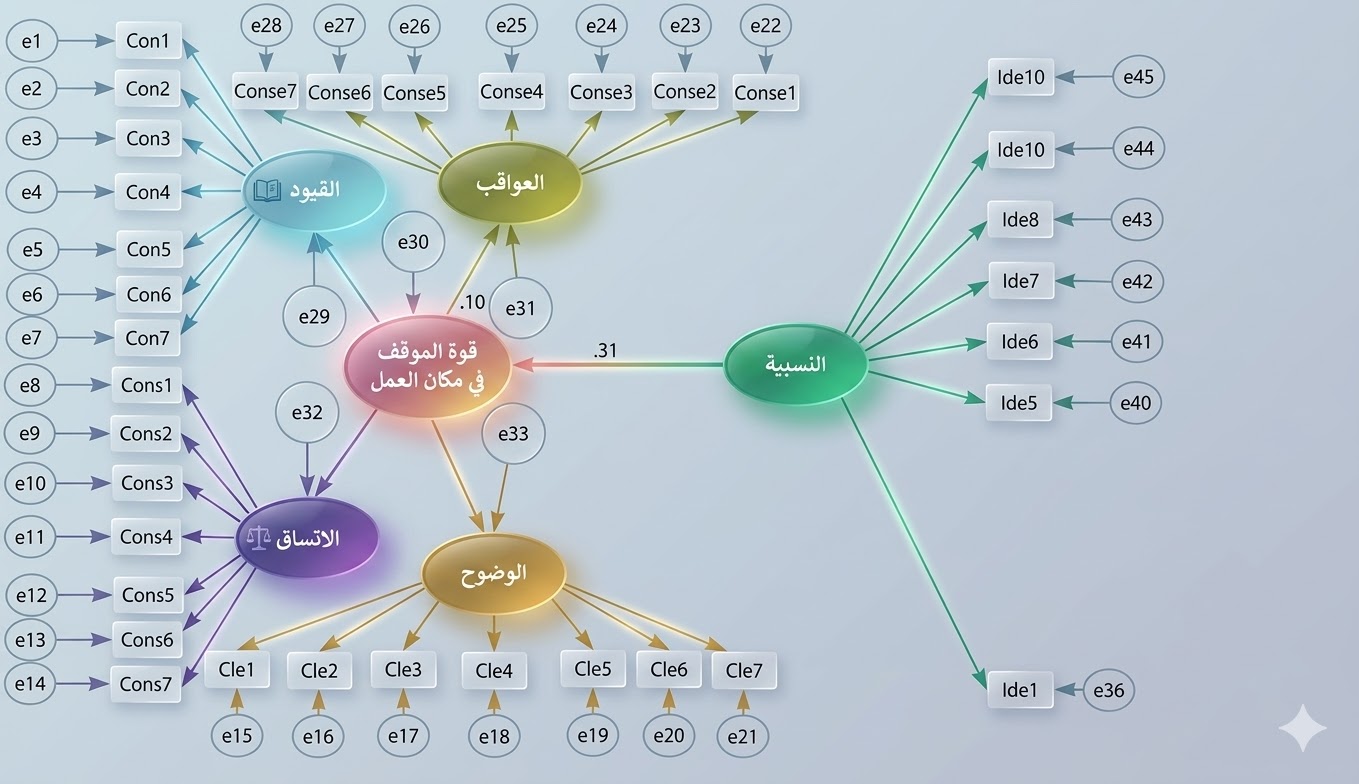
This study aims to investigate the effect of individual ethical ideology on situational strength in the workplace by examining the relationship between the two dimensions of ethical ideology (idealism and relativism) and the elements of situational strength (clarity, consistency, constraints, and consequences). The research adopted an analytical approach, both theoretical and empirical. The empirical part was conducted on a random sample of 150 employees from the Directorate of Water Resources in Karbala, using an electronic questionnaire as the primary data collection tool. Data were analyzed through (SPSS V.25) and (AMOS V.23).
The results revealed a statistically significant correlation and impact between ethical ideology and situational strength. Employees with an idealistic orientation demonstrated greater alignment with the dimensions of clarity and consistency, whereas those with a relativistic orientation showed more variability in perceiving constraints and consequences. The study highlights the importance of enhancing employees’ ethical awareness and designing training programs that reflect individual value orientations, thereby fostering professional discipline and improving institutional performance.
Downloads
References
1. عبيد، عبد الله عبد الرحمن (2014). أساسيات البحث العلمي: المفاهيم والخطوات والتطبيقات، ط1، عمان: دار صفاء للنشر والتوزيع.
2. الزبيدي، علاء كريم محسن (2018). منهجية البحث العلمي وتطبيقاتها في بحوث الإدارة، ط1، بغداد: دار الكتب العلمية.
3. Anwar, J., & Hasnu, S. A. F. (2013). Ideology, purpose, core values and leadership: How they influence the vision of an organization. International Journal of Learning and Development, 3(3), 168–184.
4. Barnett, T., Bass, K., & Brown, G. (1994). Ethical ideology and ethical judgment regarding ethical issues in business. Journal of Business Ethics, 13(6), 469–480.
5. Bem, D. J. (1983). Gender schema theory and its implications for child development: Raising gender-aschematic children in a gender-schematic society. Signs: Journal of Women in Culture and Society, 8(4), 598–616
6. Beu, D. S., Buckley, M. R., & Harvey, M. G. (2003). Ethical decision–making: A multidimensional construct. Business Ethics: A European Review, 12(1), 63–73.
7. Beu, D. S., Buckley, M. R., & Harvey, M. G. (2003). Ethical decision–making: A multidimensional construct. Business Ethics: A European Review, 12(1), 63–73.
8. Boston, J. (2010). Why ethics matters: The implications of ethical theory for the design and practice of public policy. In Boston, J., Bradstock, A., & Eng, D. (Eds.), Public Policy: Why ethics matters (pp. 1–24)
9. Brady, F. N., & Wheeler, G. E. (1996). An empirical study of ethical predispositions. Journal of business ethics, 15(9), 927-940.
10. Buye, R. (2021). The ethical basis for public policy making and evaluation. Preprint manuscript
11. Calderwood, C., Meyer, R. D., & Minnen, M. E. (2023). Situational strength as a lens to understand the strain implications of extra-normative work. Journal of Business and Psychology, 38(3), 637-655.
12. Calderwood, C., Meyer, R. D., & Minnen, M. E. (2023). Situational strength as a lens to understand the strain implications of extra-normative work. Journal of Business and Psychology, 38(3), 637-655.
13. Chen, E. S., & Tyler, T. R. (2001). Cloaking power: Legitimizing myths and the psychology of the advantaged.: A. Y. Lee-Chai & J. A. Bargh (Eds.), The Use and Abuse of Power.
14. Cherpas, C. (1993). The concept of strength in the analysis of verbal behavior. The Analysis of Verbal Behavior, 11(1), 55–62.
15. Church, A. T., Katigbak, M. S., del Pilar, J., & Reyes, J. A. (2008). Trait and situational determinants of cross‑situational consistency in behavior: Evidence from cultural comparisons. Journal of Personality and Social Psychology, 95(1), 150–164.
16. Cooper, W. H., & Withey, M. J. (2009). The strong situation hypothesis. Personality and Social Psychology Review, 13(1), 62-72.
17. Dalal, R., & Meyer, R. (2012). The implications of situational strength for HRM. The Encyclopedia of Human Resource Management: Thematic Essays, 298–306.
18. Duckitt, J., & Fisher, K. (2003). The impact of social threat on worldview and ideological attitudes. Political Psychology, 24(1), 199–222.
19. Duckitt, J., & Fisher, K. (2003). The impact of social threat on worldview and ideological attitudes. Political Psychology, 24(1), 199–222.
20. Forsyth, D. R. (1980). A taxonomy of ethical ideologies. Journal of Personality and Social psychology, 39(1), 175.
21. Forsyth, D. R. (1992). Judging the morality of business practices: The influence of personal moral philosophies. Journal of Business Ethics, 11(5-6), 461–470
22. Freudenstein, J. P., Schäpers, P., Reznik, N., Stolte, T., & Krumm, S. (2024). The influence of situational strength on the relation of personality and situational judgment test performance. International Journal of Selection and Assessment, 32(1), 1-11.
23. García-Arroyo, J., Cárdenas Moncayo, I., Gómez García, A. R., & Osca Segovia, A. (2021). Understanding the relationship between situational strength and burnout: A multi-sample analysis. International Journal of Environmental Research and Public Health, 18(1), 162..
24. Glaeser, E. L. (2003). Psychology and the market. Social Science Research Network.
25. Green, A. W. (1942). The social situation in personality theory. American Sociological Review, 7(3), 388.
26. Güçlüol, K. (1986). Gençlik ve idealizm. Education and Science, 10(60).
27. Haidt, J. (2012). The righteous mind: Why good people are divided by politics and religion. New York: Pantheon Books
28. Hanson, J., & Yosifon, D. (2003). The situation: An introduction to the situational character, critical realism, power economics, and deep capture. U. Pa. L. Rev., 152, 129.
29. Helzer, E. G., Cohen, T. R., & Kim, Y. (2022). *The character lens: A person‑centered perspective on moral recognition .
30. Hunt, S. D., & Vitell, S. J. (1989). The general theory of marketing ethics. Journal of Macromarketing, 8(1), 5–16
31. Ismail, S., & Rasheed, A. (2019). Influence of ethical ideology and emotional intelligence on the ethical judgement of future accountants in Malaysia. Meditari Accountancy Research, 27(5), 795–816
32. Judge, T. A., & Zapata, C. P. (2015). The person–situation debate revisited: Effect of situation strength and trait activation on the validity of the Big Five personality traits in predicting job performance. Academy of Management Journal, 58(4), 1149-1179
33. LaFollette, H. (1991). The truth in ethical relativism. Journal of Social Philosophy, 22(3), 146–154
34. Li, R., Balliet, D., Thielmann, I., & De Vries, R. E. (2024). Revisiting situational strength: Do strong situations restrict variance in behaviors?. Journal of Personality and Social Psychology.
35. Lipiansky, E. M. (1991). Représentations sociales et ideologies: Analyse conceptuelle. ، In V. Aebischer, J.–P. Deconchy, & E. M. Lipiansky (Eds.), Idéologies et représentations sociales.
36. Lodge, M. (1982). Political ideology: Its structure, functions, and elective affinities (p. 85). New York: Columbia University Press
37. Miller, R. W. (1985). Ways of moral learning. The Philosophical Review, 94(4), 507–556.
38. McFerran, B., Aquino, K., & Duffy, M. K. (2010). How personality and moral identity relate to individuals’ ethical ideology. Business Ethics Quarterly, 20(1), 35–56
39. Meyer, R. D., Dalal, R. S., & Hermida, R. (2010). A review and synthesis of situational strength in the organizational sciences. Journal of Management, 36(1), 121–140
40. Mischel, W. (1977). The interaction of person and situation. Personality at the crossroads: Current issues in interactional psychology, 333, 352.
41. Moore, C., Detert, J. R., Treviño, L. K., Baker, V. L., & Mayer, D. M. (2012). Why employees do bad things: Moral disengagement and unethical organizational behavior. Personnel Psychology, 65(1), 1–48.
42. Morse, P. J. (2016). Quantifying the strength of situations: A psychometric approach to assessing situational strength (Doctoral dissertation, University of Illinois at Urbana-Champaign). ProQuest Dissertations Publishing.
43. Newman, A., & Ford, R. C. (2015). Consequences of decision-making in high-stakes contexts: Behavioral implications for workplace performance. Journal of Business Ethics, 126(2), 253–269
44. Papastamou, S. (2008). Eisagogí stin koinonikí psychología [Introduction in Social Psychology]. Pedío
45. Pearson, S., Grandon, E., & Cho, S. (2018). The impact of organizational stakes on employee compliance and risk-taking: A situational strength perspective. Human Resource Management Review, 28(3), 410–423
46. Rodriguez, M. (2022). Perceived outcome importance and accountability: Effects on employee decision-making. Journal of Organizational Behavior, 43(1), 60–72.
47. Ross, M. W., & Ferreira-Pinto, J. (2000). Toward a public health of situations: the re-contextualization of risk. Cadernos de Saúde Pública, 16(1), 59–71.
48. Roszkowska, P., Kostrzewa, M., & Krol, K. (2021). Organizational moral structure: A comprehensive framework of interrelated organizational factors conditioning ethical behavior. Journal of Business Ethics, 174, 5‑23
49. Schlenker, B. R., & Forsyth, D. R. (1977). On the ethics of psychological research: Judgment and individual moral philosophy. Journal of Experimental Social Psychology, 13(4), 369–394
50. Sivadas, E., Bardi Kleiser, S., Kellaris, J., & Dahlstrom, R. (2003). Moral philosophy, ethical evaluations, and sales manager hiring intentions. Journal of Personal Selling & Sales Management, 23(1), 7-21.
51. Snyder, M., & Ickes, W. (1985). Personality and social behavior. In G. Lindzey & E. Aronson (Eds.), Handbook of social psychology (3rd ed., Vol. 2, pp. 883–948). New York: Random House.
52. Suasthi, I. G. A. (2018). Analisis Swot Konsep Dasar Filsafat Idealisme Implikasi dan Aplikasi dalam Pendidikan. Sanjiwani: Jurnal Filsafat, 9(1), 1-7.
53. Thurstone, L. L. (1931). The measurement of social attitudes. The journal of abnormal and social psychology, 26(3), 249.
54. Trevino, L. K., Weaver, G. R., & Reynolds, S. J. (2006). Behavioral ethics in organizations: A review. Journal of Management, 32(6), 951–990.
55. Tsitseli, A., & Prodromitis, G. (2023). The moral reasoning of ideology: The mediating role of moral foundations, moral absolutism, and consistency norm. The Spanish Journal of Psychology, 26, e18, 1–16.
56. Turner, N., Barling, J., & Zacharatos, A. (2024).Enhancing employee safety through transformational leadership.In Occupational Health Psychology: Challenges and Opportunities (2nd ed., pp. 105–130). Springer
57. Vaisey, S. (2009). Motivation and justification: A dual-process model of culture in action. American Journal of Sociology, 114(6), 1675–1715
58. Wang, F., Wang, X., & Zhu, Y. (2017).The effect of anonymity on cooperation in social dilemmas: A meta-analysis.Acta Psychologica Sinica, 49(4), 35–48.
59. Waytz, A., Iyer, R., Young, L., Haidt, J., & Graham, J. (2019). Ideological differences in the expanse of the moral circle. Nature Communications, 10(1), 4389.
60. Weiss, H. M., & Adler, S. (1984). Personality and organizational behavior. Research in Organizational Behavior
61. Withey, M. J., Gellatly, I. R., & Annett, M. (2005). The Moderating Effect of Situation Strength on the Relationship Between Personality and Provision of Effort 1. Journal of Applied Social Psychology, 35(8), 1587-1606.
62. Yelen, D. (1969). The effects of strength of competing responses during conflict. Psychonomic Science, 15(2), 80–81.
Downloads
Published
How to Cite
Issue
Section
License
Copyright (c) 2026 ابتهاء غازي عبد الرضا، ميثاق هاتف الفتلاوي

This work is licensed under a Creative Commons Attribution-NonCommercial-NoDerivatives 4.0 International License.
Authors retain the copyright of their papers without restrictions.