تأثير الأيديولوجيا الأخلاقية للفرد في قوة الموقف في مكان العمل
DOI:
https://doi.org/10.71207/ijas.v22i87.5807الكلمات المفتاحية:
الأيديولوجيا الأخلاقية، قوة الموقف في مكان العملالملخص
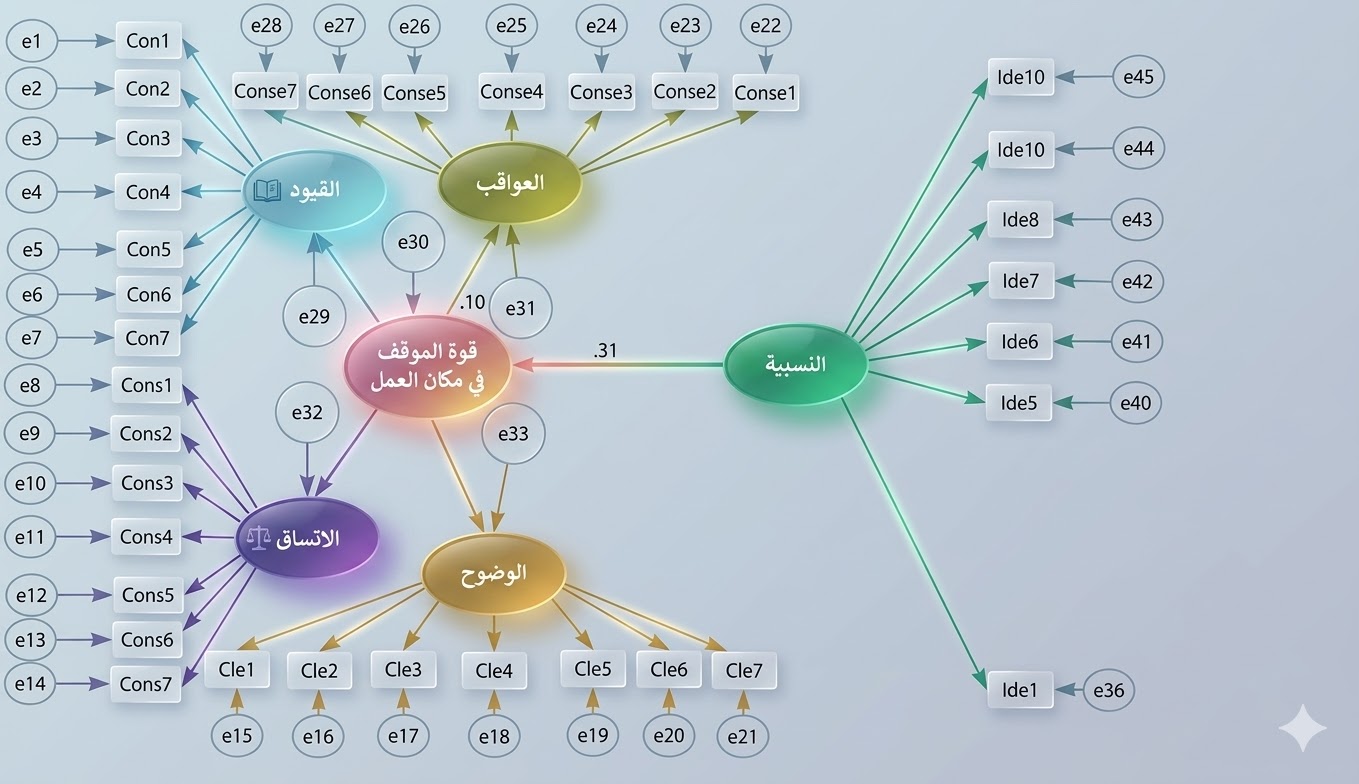
تهدف هذا الدراسة إلى تقصّي تأثير الأيديولوجيا الأخلاقية للفرد في قوة الموقف داخل بيئة العمل، من خلال دراسة العلاقة بين بُعدي الأيديولوجيا الأخلاقية (المثالية والنسبية) وعناصر قوة الموقف (الوضوح، الاتساق، القيود، العواقب). استند البحث إلى المنهج التحليلي بشقيه النظري والميداني، إذ جرى تطبيق الجانب العملي على عينة عشوائية مكونة من (150) موظفًا في مديرية الموارد المائية في كربلاء، باستخدام استبانة إلكترونية كأداة رئيسة لجمع البيانات، وتحليلها عبر برنامجي (SPSS V.25) و(AMOS V.23).
أظهرت النتائج وجود علاقة ارتباط وتأثير دال إحصائيًا بين الأيديولوجيا الأخلاقية وقوة الموقف، حيث اتسم الموظفون ذوو النزعة المثالية بقدرة أعلى على التكيف مع بُعدي الوضوح والاتساق، فيما أظهر ذوو النزعة النسبية تفاوتًا في استجابتهم لبُعدي القيود والعواقب. وتوصلت الدراسة إلى أهمية تعزيز الوعي الأخلاقي لدى الموظفين وتبني برامج تدريبية تتناسب مع اختلافاتهم القيمية، بما يدعم الانضباط المهني ويُعزز كفاءة الأداء المؤسسي.
التنزيلات
المراجع
1. عبيد، عبد الله عبد الرحمن (2014). أساسيات البحث العلمي: المفاهيم والخطوات والتطبيقات، ط1، عمان: دار صفاء للنشر والتوزيع.
2. الزبيدي، علاء كريم محسن (2018). منهجية البحث العلمي وتطبيقاتها في بحوث الإدارة، ط1، بغداد: دار الكتب العلمية.
3. Anwar, J., & Hasnu, S. A. F. (2013). Ideology, purpose, core values and leadership: How they influence the vision of an organization. International Journal of Learning and Development, 3(3), 168–184.
4. Barnett, T., Bass, K., & Brown, G. (1994). Ethical ideology and ethical judgment regarding ethical issues in business. Journal of Business Ethics, 13(6), 469–480.
5. Bem, D. J. (1983). Gender schema theory and its implications for child development: Raising gender-aschematic children in a gender-schematic society. Signs: Journal of Women in Culture and Society, 8(4), 598–616
6. Beu, D. S., Buckley, M. R., & Harvey, M. G. (2003). Ethical decision–making: A multidimensional construct. Business Ethics: A European Review, 12(1), 63–73.
7. Beu, D. S., Buckley, M. R., & Harvey, M. G. (2003). Ethical decision–making: A multidimensional construct. Business Ethics: A European Review, 12(1), 63–73.
8. Boston, J. (2010). Why ethics matters: The implications of ethical theory for the design and practice of public policy. In Boston, J., Bradstock, A., & Eng, D. (Eds.), Public Policy: Why ethics matters (pp. 1–24)
9. Brady, F. N., & Wheeler, G. E. (1996). An empirical study of ethical predispositions. Journal of business ethics, 15(9), 927-940.
10. Buye, R. (2021). The ethical basis for public policy making and evaluation. Preprint manuscript
11. Calderwood, C., Meyer, R. D., & Minnen, M. E. (2023). Situational strength as a lens to understand the strain implications of extra-normative work. Journal of Business and Psychology, 38(3), 637-655.
12. Calderwood, C., Meyer, R. D., & Minnen, M. E. (2023). Situational strength as a lens to understand the strain implications of extra-normative work. Journal of Business and Psychology, 38(3), 637-655.
13. Chen, E. S., & Tyler, T. R. (2001). Cloaking power: Legitimizing myths and the psychology of the advantaged.: A. Y. Lee-Chai & J. A. Bargh (Eds.), The Use and Abuse of Power.
14. Cherpas, C. (1993). The concept of strength in the analysis of verbal behavior. The Analysis of Verbal Behavior, 11(1), 55–62.
15. Church, A. T., Katigbak, M. S., del Pilar, J., & Reyes, J. A. (2008). Trait and situational determinants of cross‑situational consistency in behavior: Evidence from cultural comparisons. Journal of Personality and Social Psychology, 95(1), 150–164.
16. Cooper, W. H., & Withey, M. J. (2009). The strong situation hypothesis. Personality and Social Psychology Review, 13(1), 62-72.
17. Dalal, R., & Meyer, R. (2012). The implications of situational strength for HRM. The Encyclopedia of Human Resource Management: Thematic Essays, 298–306.
18. Duckitt, J., & Fisher, K. (2003). The impact of social threat on worldview and ideological attitudes. Political Psychology, 24(1), 199–222.
19. Duckitt, J., & Fisher, K. (2003). The impact of social threat on worldview and ideological attitudes. Political Psychology, 24(1), 199–222.
20. Forsyth, D. R. (1980). A taxonomy of ethical ideologies. Journal of Personality and Social psychology, 39(1), 175.
21. Forsyth, D. R. (1992). Judging the morality of business practices: The influence of personal moral philosophies. Journal of Business Ethics, 11(5-6), 461–470
22. Freudenstein, J. P., Schäpers, P., Reznik, N., Stolte, T., & Krumm, S. (2024). The influence of situational strength on the relation of personality and situational judgment test performance. International Journal of Selection and Assessment, 32(1), 1-11.
23. García-Arroyo, J., Cárdenas Moncayo, I., Gómez García, A. R., & Osca Segovia, A. (2021). Understanding the relationship between situational strength and burnout: A multi-sample analysis. International Journal of Environmental Research and Public Health, 18(1), 162..
24. Glaeser, E. L. (2003). Psychology and the market. Social Science Research Network.
25. Green, A. W. (1942). The social situation in personality theory. American Sociological Review, 7(3), 388.
26. Güçlüol, K. (1986). Gençlik ve idealizm. Education and Science, 10(60).
27. Haidt, J. (2012). The righteous mind: Why good people are divided by politics and religion. New York: Pantheon Books
28. Hanson, J., & Yosifon, D. (2003). The situation: An introduction to the situational character, critical realism, power economics, and deep capture. U. Pa. L. Rev., 152, 129.
29. Helzer, E. G., Cohen, T. R., & Kim, Y. (2022). *The character lens: A person‑centered perspective on moral recognition .
30. Hunt, S. D., & Vitell, S. J. (1989). The general theory of marketing ethics. Journal of Macromarketing, 8(1), 5–16
31. Ismail, S., & Rasheed, A. (2019). Influence of ethical ideology and emotional intelligence on the ethical judgement of future accountants in Malaysia. Meditari Accountancy Research, 27(5), 795–816
32. Judge, T. A., & Zapata, C. P. (2015). The person–situation debate revisited: Effect of situation strength and trait activation on the validity of the Big Five personality traits in predicting job performance. Academy of Management Journal, 58(4), 1149-1179
33. LaFollette, H. (1991). The truth in ethical relativism. Journal of Social Philosophy, 22(3), 146–154
34. Li, R., Balliet, D., Thielmann, I., & De Vries, R. E. (2024). Revisiting situational strength: Do strong situations restrict variance in behaviors?. Journal of Personality and Social Psychology.
35. Lipiansky, E. M. (1991). Représentations sociales et ideologies: Analyse conceptuelle. ، In V. Aebischer, J.–P. Deconchy, & E. M. Lipiansky (Eds.), Idéologies et représentations sociales.
36. Lodge, M. (1982). Political ideology: Its structure, functions, and elective affinities (p. 85). New York: Columbia University Press
37. Miller, R. W. (1985). Ways of moral learning. The Philosophical Review, 94(4), 507–556.
38. McFerran, B., Aquino, K., & Duffy, M. K. (2010). How personality and moral identity relate to individuals’ ethical ideology. Business Ethics Quarterly, 20(1), 35–56
39. Meyer, R. D., Dalal, R. S., & Hermida, R. (2010). A review and synthesis of situational strength in the organizational sciences. Journal of Management, 36(1), 121–140
40. Mischel, W. (1977). The interaction of person and situation. Personality at the crossroads: Current issues in interactional psychology, 333, 352.
41. Moore, C., Detert, J. R., Treviño, L. K., Baker, V. L., & Mayer, D. M. (2012). Why employees do bad things: Moral disengagement and unethical organizational behavior. Personnel Psychology, 65(1), 1–48.
42. Morse, P. J. (2016). Quantifying the strength of situations: A psychometric approach to assessing situational strength (Doctoral dissertation, University of Illinois at Urbana-Champaign). ProQuest Dissertations Publishing.
43. Newman, A., & Ford, R. C. (2015). Consequences of decision-making in high-stakes contexts: Behavioral implications for workplace performance. Journal of Business Ethics, 126(2), 253–269
44. Papastamou, S. (2008). Eisagogí stin koinonikí psychología [Introduction in Social Psychology]. Pedío
45. Pearson, S., Grandon, E., & Cho, S. (2018). The impact of organizational stakes on employee compliance and risk-taking: A situational strength perspective. Human Resource Management Review, 28(3), 410–423
46. Rodriguez, M. (2022). Perceived outcome importance and accountability: Effects on employee decision-making. Journal of Organizational Behavior, 43(1), 60–72.
47. Ross, M. W., & Ferreira-Pinto, J. (2000). Toward a public health of situations: the re-contextualization of risk. Cadernos de Saúde Pública, 16(1), 59–71.
48. Roszkowska, P., Kostrzewa, M., & Krol, K. (2021). Organizational moral structure: A comprehensive framework of interrelated organizational factors conditioning ethical behavior. Journal of Business Ethics, 174, 5‑23
49. Schlenker, B. R., & Forsyth, D. R. (1977). On the ethics of psychological research: Judgment and individual moral philosophy. Journal of Experimental Social Psychology, 13(4), 369–394
50. Sivadas, E., Bardi Kleiser, S., Kellaris, J., & Dahlstrom, R. (2003). Moral philosophy, ethical evaluations, and sales manager hiring intentions. Journal of Personal Selling & Sales Management, 23(1), 7-21.
51. Snyder, M., & Ickes, W. (1985). Personality and social behavior. In G. Lindzey & E. Aronson (Eds.), Handbook of social psychology (3rd ed., Vol. 2, pp. 883–948). New York: Random House.
52. Suasthi, I. G. A. (2018). Analisis Swot Konsep Dasar Filsafat Idealisme Implikasi dan Aplikasi dalam Pendidikan. Sanjiwani: Jurnal Filsafat, 9(1), 1-7.
53. Thurstone, L. L. (1931). The measurement of social attitudes. The journal of abnormal and social psychology, 26(3), 249.
54. Trevino, L. K., Weaver, G. R., & Reynolds, S. J. (2006). Behavioral ethics in organizations: A review. Journal of Management, 32(6), 951–990.
55. Tsitseli, A., & Prodromitis, G. (2023). The moral reasoning of ideology: The mediating role of moral foundations, moral absolutism, and consistency norm. The Spanish Journal of Psychology, 26, e18, 1–16.
56. Turner, N., Barling, J., & Zacharatos, A. (2024).Enhancing employee safety through transformational leadership.In Occupational Health Psychology: Challenges and Opportunities (2nd ed., pp. 105–130). Springer
57. Vaisey, S. (2009). Motivation and justification: A dual-process model of culture in action. American Journal of Sociology, 114(6), 1675–1715
58. Wang, F., Wang, X., & Zhu, Y. (2017).The effect of anonymity on cooperation in social dilemmas: A meta-analysis.Acta Psychologica Sinica, 49(4), 35–48.
59. Waytz, A., Iyer, R., Young, L., Haidt, J., & Graham, J. (2019). Ideological differences in the expanse of the moral circle. Nature Communications, 10(1), 4389.
60. Weiss, H. M., & Adler, S. (1984). Personality and organizational behavior. Research in Organizational Behavior
61. Withey, M. J., Gellatly, I. R., & Annett, M. (2005). The Moderating Effect of Situation Strength on the Relationship Between Personality and Provision of Effort 1. Journal of Applied Social Psychology, 35(8), 1587-1606.
62. Yelen, D. (1969). The effects of strength of competing responses during conflict. Psychonomic Science, 15(2), 80–81.
التنزيلات
منشور
كيفية الاقتباس
إصدار
القسم
الرخصة
الحقوق الفكرية (c) 2026 ابتهاء غازي عبد الرضا، ميثاق هاتف الفتلاوي

هذا العمل مرخص بموجب Creative Commons Attribution-NonCommercial-NoDerivatives 4.0 International License.
يحتفظ المؤلفون بحقوق الطبع والنشر لأوراقهم دون قيود.