دور الذكاء الثقافي في تعزيز الاداء السياقي:
دراسة تحليلية لأراء عينة من أعضاء الهيئة التدريسية كلية الكوت الجامعة
DOI:
https://doi.org/10.71207/ijas.v22i87.5642الكلمات المفتاحية:
الذكاء الثقافي، الأداء السياقي، كلية الكوت الجامعةالملخص
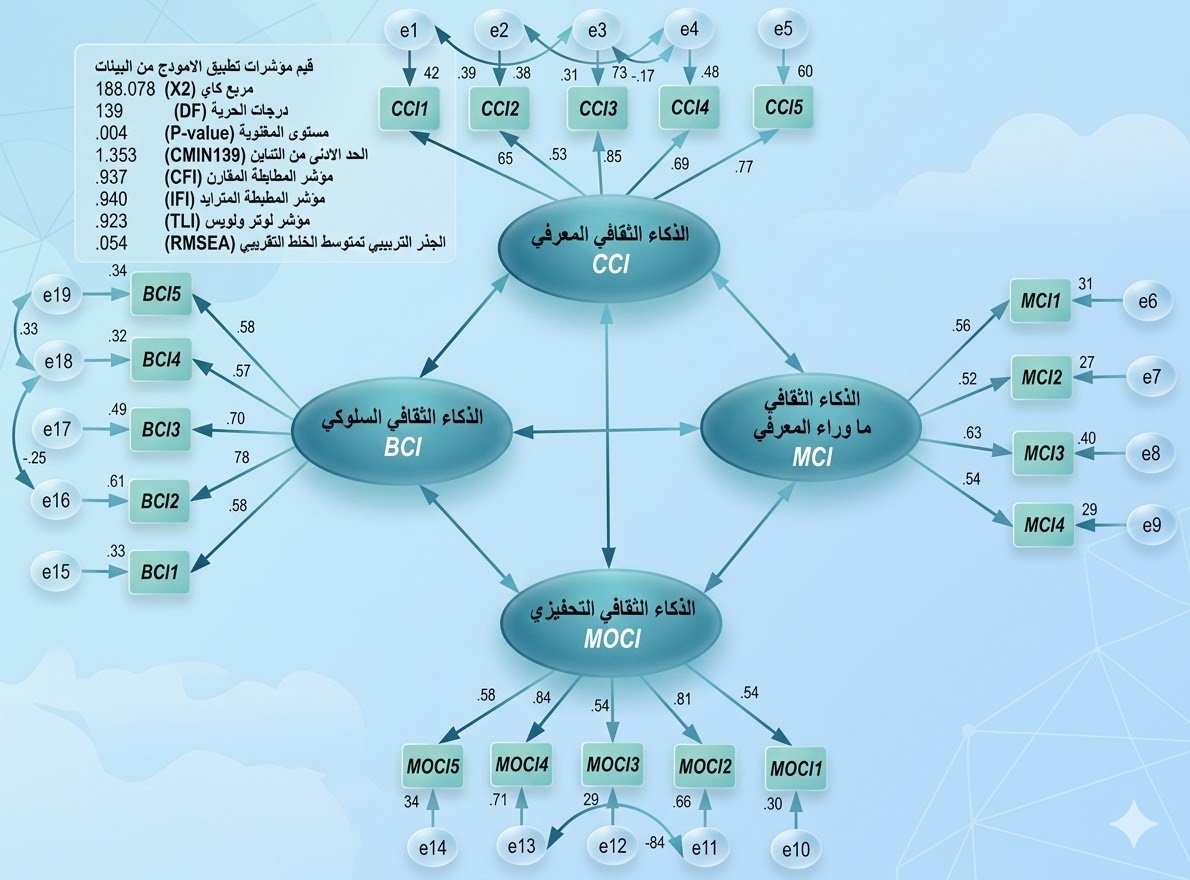
تهدف الدراسة إلى بيان دور الذكاء الثقافي بأبعاده (المعرفي، ما وراء المعرفي، التحفيزي، السلوكي) كمتغير مستقل في تعزيز الأداء السياقي بأبعاده (تسهيل العلاقات الشخصية، التفاني الوظيفي) لدى أعضاء الهيئة التدريسية في كلية الكوت الجامعة. انطلقت الدراسة من مشكلة بحثية تضمنت تساؤلات حول طبيعة العلاقة بين الذكاء الثقافي بمستوياته المختلفة والأداء السياقي، ومدى إسهام أبعاده في تفسير هذه العلاقة، بلغت عينة الدراسة (277) تدريسيًا من مجتمع يبلغ (993) تدريسيًا، واستخدمت الاستبانة كأداة رئيسة لجمع البيانات، وتم تحليلها باستخدام التحليل العاملي التوكيدي، ومعامل ارتباط بيرسون، ونمذجة المعادلات الهيكلية (SEM) عبر برنامجي SPSS وAMOS. وتوصلت النتائج إلى أن الذكاء الثقافي يؤثر إيجابيًا وبصورة معنوية في الأداء السياقي، وكان البعدان ما وراء المعرفي والتحفيزي الأكثر تأثيرًا، وأوصت الدراسة ببناء ثقافة جامعية تشجع على تنمية الذكاء الثقافي بين التدريسيين.
التنزيلات
المراجع
1. احمد، ناهد فتحي (2012) الذكاء الثقافي وعلاقته بالحكمة والعوامل الخمسة الكبرى للشخصية: صيغة مصرية من مقياس الذكاء الثقافي مجلة دراسات عربية في علم النفس، المجلد 11، العدد 3.
2. Ahmed, N., Alias, F., Hamat, M. & Mohammed, S. (2024). Reliability Analysis: Application of Cronbach's Alpha in Research Instruments. Pioneering the Future: Delving into E-Learning's Landscapep. Vol 8, p 116
3. Ang, S., Van Dyne, L., & Koh, C. (2006). Personality correlates of the four-factor model of cultural intelligence. Group & Organization Management, 31(1), 100–123. https://doi.org/10.1177/1059601105275267 .
4. Ariani, D. W. (2015). Relationship with supervisor and co-workers, psychological condition, and employee engagement in the workplace. Journal of Business and Management, 4(3).
5. Atemoagbo, O. P. (2024). Confirmatory factor analysis on climate change impact on human migration patterns and social vulnerability. International Journal of Engineering and Computer Science, 13(02), 26057–26068.
6. Aziza, A., Ben Youssef, A., & Omranin, N. (2006). Do E-skilled workers have better contextual performance? Evidence from France.
7. Bateman, T. S., & Organ, D. W. (1983). Job satisfaction and the good soldier: The relationship between affect and employee “citizenship.” Academy of Management Journal, 26(4), 587–595.
8. Bing, M. N., Davison, H. K., Minor, L., Novicevic, M. M., & Frink, D. D. (2011). The prediction of task and contextual performance by political skill: A meta-analysis and moderator test. Journal of Vocational Behavior, 79(2), 563–577.
9. Botha, N. (2014). The effect of identity and personality on cultural intelligence among a group of young South Africans (Doctoral dissertation).
10. Cabral, A. M. R., Carvalho, F. M. P., & Ferreira, J. A. V. (2020). The effect of emotional and cultural intelligences on networks’ behaviors in international SMEs: Evidence from Portugal. Behavioral Sciences, 10(11), 163.
11. Caputo, A., Ayoko, O. B., Amoo, N., & Menke, C. (2019). The relationship between cultural values, cultural intelligence, and negotiation styles. Journal of Business Research, 99, 23–36.
12. Cheng, B., & Gu, J. (2022). The test based on meta-analysis on “Does workaholism prefer task performance or contextual performance?” Frontiers in Psychology, 13, 860687.
13. D’Souza, J. B. (2022). Cultural intelligence to cultural adaptation of expatriates in Thailand. REFLections, 29(3), 739–760.
14. Earley, P. C., & Ang, S. (2003). Cultural intelligence: Individual interactions across cultures. Stanford University Press.
15. Elenkov, Detelin S. & Manev, Ivan M., (2009), Senior expatriate leadership's effects on innovation and the role of cultural intelligence, Journal of World Business, Vol. 44.
16. Gooden, D. J., Creque, C. A., & Chin-Loy, C. (2017). The impact of metacognitive, cognitive, and motivational cultural intelligence on behavioral cultural intelligence. International Business & Economics Research Journal, 16(3), 223–230.
17. Goodman, S. A., & Svyantek, D. J. (1999). Person-organization fit and contextual performance: Do shared values matter? Journal of Vocational Behavior, 55(2), 254–275.
18. Gosselin, R. D. (2024). Testing for normality: A user’s (cautionary) guide. Laboratory Animals, 58(5), 433–437.
19. Groves, K. S., & Feyerherm, A. E. (2011). Leader cultural intelligence in context. Group & Organization Management, 36(5), 535–566. https://doi.org/10.1177/1059601111415664
20. Hosie, P., & Nankervis, A. (2016). A multidimensional measure of managers’ contextual and task performance. Personnel Review, 45(2), 419–447.
21. Johnson, J. W. (2001). The relative importance of task and contextual performance dimensions to supervisor judgments of overall performance. Journal of Applied Psychology, 86(5), 984.
22. Khalid, S., ul Haq, M. A., Usman, M., & Khalid, S. (2025). Paradoxical leadership and contextual performance: Mediating role of trust and moderating role of agreeableness. Social Science Review Archives, 3(1), 2535–2553.
23. Khan, K. Z., Wang, X., Malik, S., & Ganiyu, S. A. (2020). Measuring the effects of emotional intelligence, cultural intelligence, and cultural adjustment on the academic performance of international students. Open Journal of Social Sciences, 8(9), 16.
24. Livermore, D., & Van Dyne, L. (2015). Cultural intelligence: The essential intelligence for the 21st century. International Research Journal of Applied Basic Sciences, 10(2), 245–258.
25. Lopes-Murphy, S. A. (2014). Experiences in postsecondary education that may lead to cultural intelligence: Exploring and proposing practices. International Journal of Teaching and Learning in Higher Education, 26(2), 287–296.
26. Nosratabadi, S., Bahrami, P., Palouzian, K., & Mosavi, A. (2020). Leader cultural intelligence and organizational performance. Cogent Business & Management, 7(1), 1809310.
27. Organ, D. W., Podsakoff, P. M., & MacKenzie, S. B. (2006). Organizational citizenship behavior: Its nature, antecedents, and consequences. SAGE Publications.
28. Peterson, T., Dodson, J., Sherwin, R., & Strale Jr, F. (2024). An internal consistency reliability study of the Catalyst Datafinch applied behavior analysis data collection application with autistic individuals. Cureus, 16(4).
29. Ramalu, S. A., Wei, C. C., & Rose, R. C. (2011). The effect of cultural intelligence on cross-cultural adjustment and job performance amongst expatriates in Malaysia. International Journal of Business and Social Sciences, 2(9), 59–80.
30. Ramírez, A., Burgos-Benavides, L., Sinchi, H., Quito-Calle, J. V., Díez, F. H., & Rodríguez-Díaz, F. J. (2025). Adaptation and validation of psychological assessment questionnaires using confirmatory factor analysis: A tutorial for planning and reporting analysis. Preprints.org, 1–21.
31. Rose, R. C., & Kumar, N. (2008). A review on individual differences and cultural intelligence. Journal of International Social Research, 1(4).
32. Sadeghi, T., & Terum, L. I. (2023). Dedication to work: Social workers in a Norwegian activation work context. European Journal of Social Work, 26(3), 532–546.
33. Sajampun, P. (2016). The role of cultural intelligence and communicative adaptability in lowering intercultural communication apprehension of the Thai international college students (Doctoral dissertation, National Institute of Development Administration).
34. Schlaegel, C., Richter, N. F., & Taras, V. (2021). Cultural intelligence and work-related outcomes: A meta-analytic examination of joint effects and incremental predictive validity. Journal of World Business, 56(4), Article 101209.
35. Schuck, M. B., & Wollard, K. K. (2013). A historical perspective of employee engagement: An emerging definition.
36. Sousa, C., Gonçalves, G., & Santos, J. (2019). Intercultural contact as a predictor of cultural intelligence. Universitas Psychologica, 18(2).
37. Thomas, D. C., & Van Dyne, L. (2018). A bi-factor theory of the four-factor model of cultural intelligence: Meta-analysis and theoretical extensions. Organizational Behavior and Human Decision Processes, 148, 124–144.
38. Tu, J. C., Zhang, X. Y., & Chiu, S. P. (2019). Assessing the impact of cultural intelligence on sustainable career competitive advantage for students in college of design. Sustainability, 12(1), 1–1.
39. Van Scotter, J. R., & Motowidlo, S. J. (1996). Interpersonal facilitation and job dedication as separate facets of contextual performance. Journal of Applied Psychology, 81(5), 525–531.
40. Ward, C., & Fischer, R. (2008). Personality, cultural intelligence, and cross-cultural adaptation: A study of expatriates in Singapore. In S. Ang & L. Van Dyne (Eds.), Handbook of Cultural Intelligence: Theory, Mea surement, and Applications (pp. 159–173). New York, NY: M.E. Sharpe.
41. Zainab, J. K., & Jinan, S. A. (2022). The effect of psychological capital on contextual performance. Al-Qadisiyah Journal for Administrative and Economic Sciences, 8(2), 116–140.
42. Zdravković, S., & Peković, J. (2021). The impact of the metacognitive and behavioral factors of cultural intelligence on foreign brand acceptance. The European Journal of Applied Economics, 18(1), 73–88.
التنزيلات
منشور
كيفية الاقتباس
إصدار
القسم
الرخصة
الحقوق الفكرية (c) 2026 Nada Mahdi Taban Al-Jaafari , Yazan Salem Mohammed Al-Janabi , Abdul Hussein Jassim Mohammed Al-Asadi

هذا العمل مرخص بموجب Creative Commons Attribution-NonCommercial-NoDerivatives 4.0 International License.
يحتفظ المؤلفون بحقوق الطبع والنشر لأوراقهم دون قيود.