
كيف تؤثر الدبلوماسية الاقتصادية على أداء الصادرات: وجهات نظر نظرية وتوجهات مستقبلية
DOI:
https://doi.org/10.71207/ijas.v22i87.5855الكلمات المفتاحية:
الدبلوماسية الاقتصادية، أداء الصادرات، اقتصاديات تكلفة المعاملات، الإطار المفاهيمي، العراقالملخص
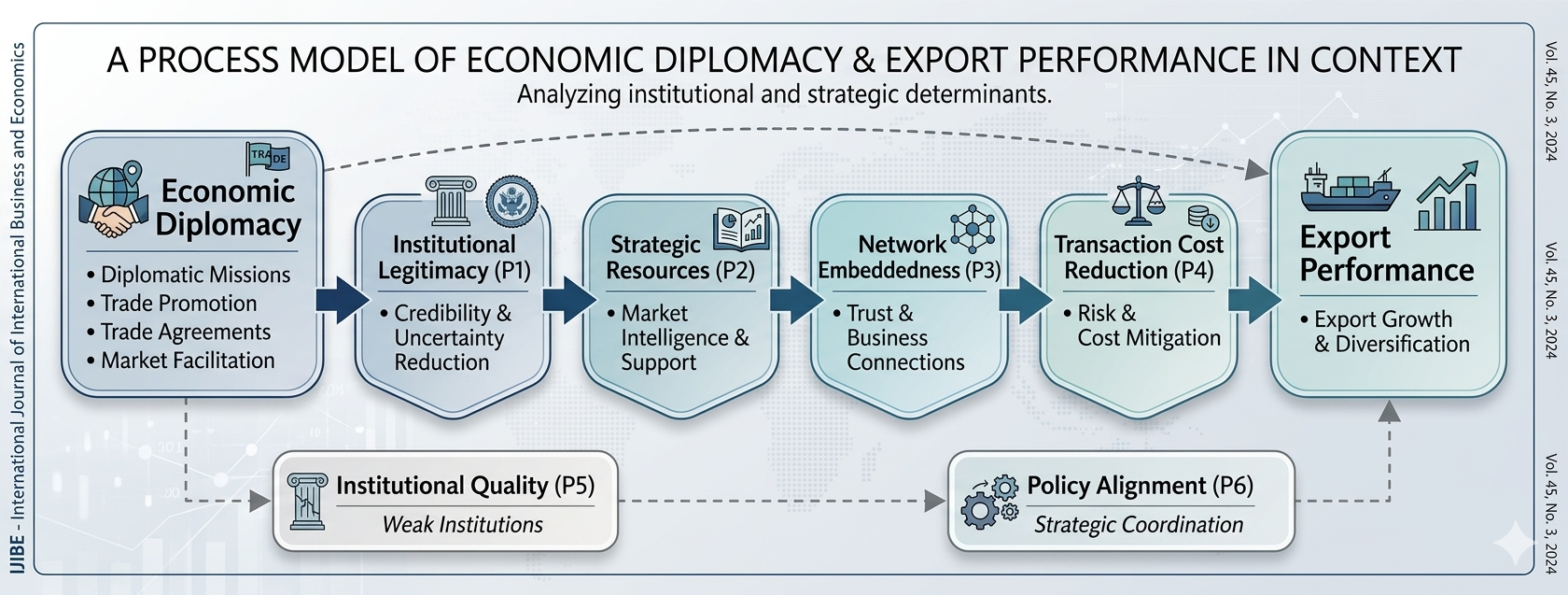
تهدف الدراسة الحالية إلى تطوير إطار مفاهيمي لاستكشاف دور الدبلوماسية الاقتصادية في ترويج الصادرات. من خلال دمج اربع اطر نظرية وهي النظرية المؤسسية، ونظرية الموارد، ونظرية الشبكات، واقتصاديات تكاليف المعاملات، تتبنى الدراسة منهجا بحثيا مفاهيميا ونظريا. تسلط الورقة الضوء على أربع آليات رئيسية تؤثر من خلالها الدبلوماسية الاقتصادية على نتائج الصادرات وهي الشرعية المؤسسية، توفير الموارد، تكامل الشبكات، وخفض تكاليف المعاملات. كما تشير الدراسة إلى الظروف السياقية التي قد تؤثر على جودة الدبلوماسية الاقتصادية، بما في ذلك جودة المؤسسات ومواءمة المبادرات الدبلوماسية مع السياسات المحلية. وتقدم مقترحات رسمية (من P1 إلى P6) لتوضيح هذه الروابط النظرية وتوجيه البحوث الميدانية مستقبلا. تستخلص الورقة بعض الدروس المناسبة للسياق العراقي وتوضح كيف يمكن للاستراتيجيات الدبلوماسية أن تحسن المصداقية المؤسسية، وتدعم الشركات المحلية، وتقلل المخاطر المرتبطة بالتجارة الدولية. فمن خلال دمج وجهات نظر نظرية متعددة واستخلاص رؤى ذات صلة بالسياسات، تساهم هذه الدراسة في الأدبيات المتعلقة بأعمال التجارة الدولية والاقتصاد الدولي، مما يوفر أساسا للاختبار الميداني وتوفير توصيات مفيدة لصناع السياسات الذين يهدفون إلى تعزيز أداء الصادرات من خلال استخدام أدوات الدبلوماسية الاقتصادية.
التنزيلات
المراجع
1. Abbasi Kamardi, A., Amoozad Mahdiraji, H., Masoumi, S., & Jafari-Sadeghi, V. (2025). Developing sustainable competitive advantages from the lens of resource-based view: evidence from IT sector of an emerging economy. Journal of Strategic Marketing, 33(6), 775–797.
2. Ahmed, B., & Islam, M. T. (2019). Bangladesh–Nepal Trade Relations: Understanding the Influence of Economic Diplomacy. Jadavpur Journal of International Relations, 23(1), 105-119.
3. Alammar, F. M., & Pauleen, D. J. (2022). Business diplomacy in practice: A strategic response to global business challenges. Journal of General Management, 48(1), 14-31.
4. Alsuwaidi, F., Raziq, M., & Batool, U. (2024). Commercial Diplomacy and Internationalization of SMEs: A Scoping Review. International Review of Management and Marketing, 14(6), 334–345.
5. Brouthers, K. D., & Nakos, G. (2004). SME entry mode choice and performance: A transaction cost perspective. Entrepreneurship Theory and Practice, 28(3), 229-247.
6. Bugarčić, F., Stekić, N., & Ćurčić, T.T. (2025). Economic diplomacy in the function of export promotion: The effects in EU versus non-EU partner countries. Politička Revija, 83(1), 103-131.
7. Csabay, M., & Cséfalvayová, K. (2022). Reconciling institutional actors of economic diplomacy: The case of Slovakia. Czech Journal of International Relations, 57(2), 7-37.
8. Ding, Z., Hu, M., & Huang, S. (2023). Diplomatic relations and firm internationalization speed: the moderating roles of trade openness and firm ownership. Management International Review, 63(6), 911-941.
9. Doh, J. P., Dahan, N. M., & Casario, M. (2022). MNEs and the practice of international business diplomacy. International Business Review, 31(1), 101926.
10. Faleye, O. A., & Igechi, O. G. (2026). Chinese economic diplomacy, public-private partnerships and Nigerian Lekki Deep Seaport. International Journal of Diplomacy and Economy, 12(1), 57-78.
11. Fernandes, A., & Forte, R. (2022). The impact of economic diplomacy on exports: The Portuguese case. International Journal: Canada’s Journal of Global Policy Analysis, 77(2), 216-247.
12. Garlick, J., & Havlová, R. (2020). China’s “Belt and Road” Economic Diplomacy in the Persian Gulf: Strategic Hedging amidst Saudi–Iranian Regional Rivalry. Journal of Current Chinese Affairs, 49(1), 82-105.
13. Hübler, M. (2016) A new trade network theory: What economists can learn from engineers. Economic Modelling, 55, 115-126.
14. Jabareen, Y. (2009). Building a conceptual framework: Philosophy, definitions, and procedure. International Journal of Qualitative Methods, 8(4), 49–62.
15. Jongwanich, J. (2025). Free trade agreements (FTAs) and export structures: evidence from Thailand. Journal of the Asia Pacific Economy, 30(2), 483–521.
16. Kacziba, P. (2021). The network analysis of international relations: Overview of an emergent methodology. Journal of International Studies, 14(3), 155-171.
17. Kamanga, P. (2025). The Trade Impact of the Creation/Disbandment of Diplomatic Relations: The Case Involving Mainland China and Chinese Taiwan. Review of International Economics, 33(4), 870-885.
18. Leitão, N. C. (2023). The Impact of Geopolitical Risk on Portuguese Exports. Economies, 11(12), 291.
19. Li, J., Meyer, K. E., Zhang, H., & Ding, Y. (2018). Diplomatic and corporate networks: Bridges to foreign locations. Journal of International Business Studies, 49(6), 659-683.
20. Li, Z., & Liu, L. (2025). Diplomatic relations and agricultural trade. Journal of Comparative Economics, 53(2), 433-460.
21. Moons, S. J., & van Bergeijk, P. A. (2017). Does economic diplomacy work? A meta‐analysis of its impact on trade and investment. The World Economy, 40(2), 336-368.
22. Mouloud, K. (2021). The role of commercial diplomacy in industrial exports promotion in the post COVID-19 era. Revue Algérienne des Sciences Juridiques et Politiques, 58(2), 326-346.
23. Muter, M.A. (2025). The role of trade policies and digitalization in enhancing export resilience to external shocks: Evidence from selected oil-exporting countries. Iraqi Journal for Administrative Sciences, 21(86), 300-315.
24. Naray, O., & Bezençon, V. (2017). Management and Business Research on Commercial Diplomacy: Examining Trends and Themes. The International Trade Journal, 31(4), 332–359.
25. Okano-Heijmans, M. (2011). Conceptualizing economic diplomacy: The crossroads of international relations, economics, IPE and diplomatic studies. The Hague Journal of Diplomacy, 6(1-2), 7-36.
26. Okano-Heijmans, M. (2012). Japan’s new economic diplomacy: Changing tactics or strategy? Asia-Pacific Review, 19(1), 62–87.
27. Pacheco, L. M., & Matos, A. P. (2022). Foreign presence and export performance: The role of Portuguese commercial diplomacy. The International Trade Journal, 36(2), 147-169.
28. Peternel, I., & Grešš, M. (2021). Economic diplomacy: Concept for economic prosperity in Croatia. Economic research-Ekonomska Istraživanja, 34(1), 109-121.
29. Pontes, D., Santos, V., Samões, O., Wang, S., & Figueiredo, R. (2024). Towards Internationalization: Exploring Economic Diplomacy in the Middle East (GCC). Economies, 12(4), 82.
30. Rose, A. K. (2007). The foreign service and foreign trade: Embassies as export promotion. The World Economy, 30(1), 22–38.
31. Ruël, H. (2020). Multinational corporations as diplomatic actors: An exploration of the concept of business diplomacy. Diplomatica, 2(1), 1-12.
32. Safari, A., & Saleh, A. S. (2020). Key determinants of SMEs’ export performance: a resource-based view and contingency theory approach using potential mediators. Journal of Business & Industrial Marketing, 35(4), 635-654.
33. Sui, S., & Bull, J. (2025). Indigenous SMEs and nonmarket strategy: leveraging cultural capital, sustainability and Indigenous diplomacy in international business. Multinational Business Review, Vol. ahead-of-print, 1-15.
34. Sultan, H. E. M., Salem, M. M. S., & El-Rahman, E. M. A. (2025). China’s economic diplomacy in Saudi Arabia and Qatar: An effect on the country’s economic growth. China Report, 61(2), 223-248.
35. Truong, L. D., Nguyen, N. T., & Nguyen, D. T. (2025). The asymmetric effects of geopolitical risks on Vietnam’s exports. Risks, 13(11), 218.
36. Tsitsoglou, P., & Zarotiadis, G. (2025). Commercial diplomacy: Conceptual analysis and factors shaping its empirical impact on trade and investments. International Journal of Diplomacy and Economy, 11(1), 63-81.
37. Vigfusson, K., Johannsdottir, L., Olafsson, S., & Köseoglu, M. A. (2025). Integrating resource-based and market-based views in the fisheries industry–CEO perspectives. Marine Policy, 171, 106454.
38. Visser, R. (2019). The effect of diplomatic representation on trade: A panel data analysis. The World Economy, 42(1), 197-225.
39. Wardani, R. Y., Cooray, N., & Waruwu, A. H. (2025). The Regional Comprehensive Economic Partnership as an Economic Architecture for the Asia-Pacific Amid Geopolitical Uncertainty. European Journal of East Asian Studies, 24(3), 376-401.
40. Webster, J., & Watson, R. T. (2002). Analyzing the past to prepare for the future: Writing a literature review. MIS Quarterly, 26(2), xiii–xxiii.
41. Williamson, O.E. (1989). Transaction cost economics. Handbook of Industrial Organization, Vol. 1, 135-182.
42. Woolcock, S. (Ed.). (2025). The New Economic Diplomacy: Decision-Making and Negotiation in International Economic Relations (5th Ed.). Routledge.
43. Zhou, J., & Lin, G. (2025). Does trade still follow the “flag”? Evidence from the partnership and bilateral trade in China. Journal of the Asia Pacific Economy, 30(2), 522-550.
التنزيلات
منشور
كيفية الاقتباس
إصدار
القسم
الرخصة
الحقوق الفكرية (c) 2026 ياسمين نجم عبد الله محسن السعد

هذا العمل مرخص بموجب Creative Commons Attribution-NonCommercial-NoDerivatives 4.0 International License.
يحتفظ المؤلفون بحقوق الطبع والنشر لأوراقهم دون قيود.