التنسيق بين السياسة النقدية والسياسة المالية في تحقيق الاستقرار الاقتصادي في العراق خلال المدة (2005-2024)
DOI:
https://doi.org/10.71207/ijas.v22i87.5877الكلمات المفتاحية:
السياسة النقدية، السياسة المالية، الاستقرار الاقتصادي، فجوة الناتجالملخص
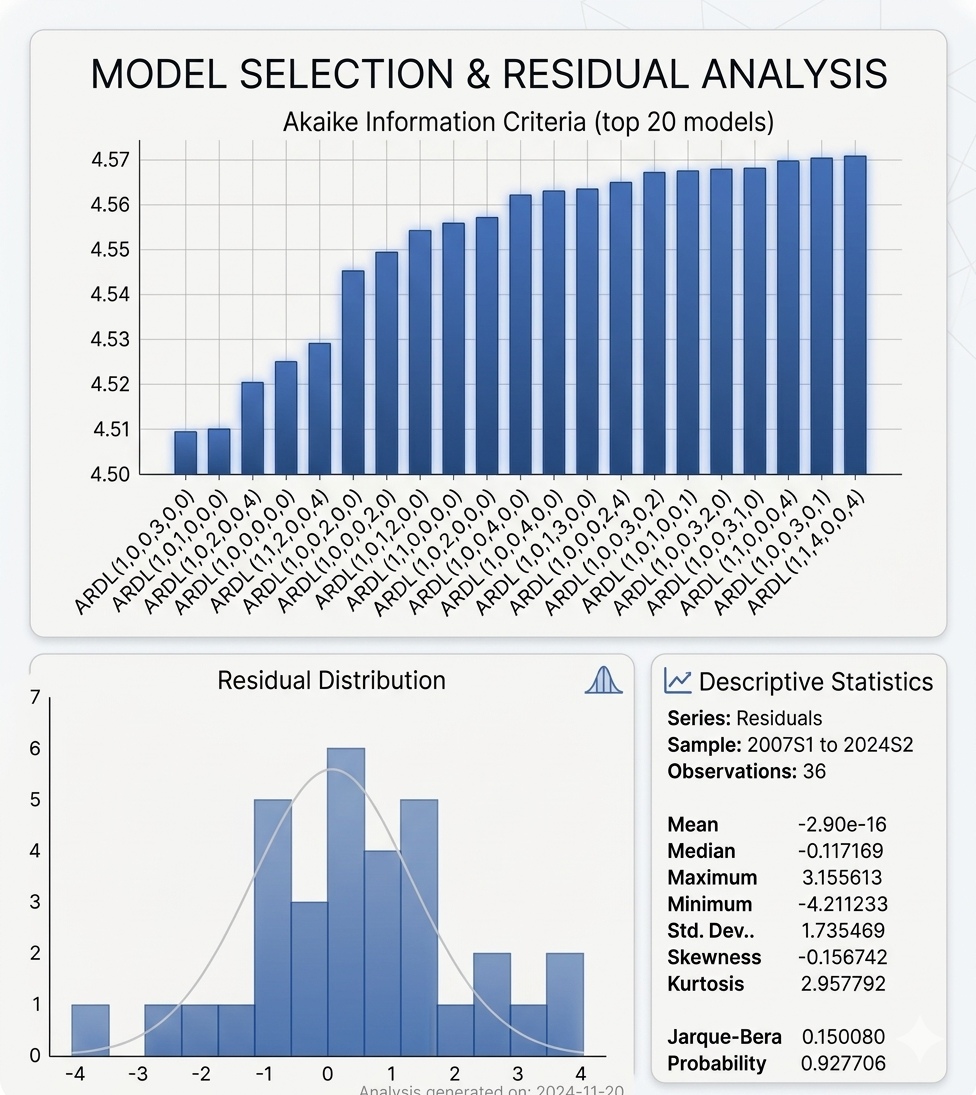
تهدف هذه الدراسة إلى تحليل أثر تنسيق السياسة النقدية والسياسة المالية في تحقيق الاستقرار الاقتصادي في العراق باستخدام فجوة الناتج كمؤشر كلي، بالاعتماد على نموذج ARDL. وتظهر النتائج وجود علاقة توازنية طويلة الأجل، مع فاعلية واضحة للائتمان المصرفي والإنفاق العام في تقليص فجوة الناتج، مقابل تأثير سلبي ومعنوي للتضخم، في حين كان تأثير سعر الفائدة ضعيفاً وغير معنوي إحصائياً، كما جاءت الإيرادات العامة بإشارة موجبة غير معنوية لاعتمادها على الإيرادات النفطية وانتقال أثرها عبر الإنفاق العام. وتخلص الدراسة إلى ضرورة تعزيز التنسيق المؤسسي بين السياستين النقدية والمالية، وإدارة السيولة والائتمان، وضبط التضخم، ورفع كفاءة الإنفاق العام لتحقيق الاستقرار الاقتصادي في العراق.
التنزيلات
المراجع
1. بوعمرة, بن عبد الفتاح, & دحمان. (2019). أثر السياسات النقدية والمالية على النمو الاقتصادي في الدول العربية خلال الفترة (1995- 2016). ,التكامل الاقتصادي. 7(3), 19-31
2. د. عبدالسلام مسعود خليفة رحومه. (2022). أثر السياسة المالية والنقدية على النمو الاقتصادي. Aljameai, (36).
3. عبد الرزاق, بن عمرة, عبد العزيز, & مقراني. (2021). أثر السياسات النقدية والمالية على بعض مؤشرات التوازن الداخلي في الجزائر دراسة تحليلية قياسية خلال الفترة 1990-2018. مجلة البشائر الاقتصادية, 7(1), 94-113.
4. فيصل غازي بلباس، و اوس فخر الدين الجويجاتي. (2022). أثر السياسة النقدية والمالية في التاثير على الناتج المحلي الاجمالي في العراقخلال المدة (1990-2020). مجلة تكريت للعلوم الادارية والاقتصادية، Doi: www.doi.org/10.25130/tjaes.18.60.3.17 ، الصفحات 318-334 .
5. كمال كاظم الشمري، و ابتهال احمد عبد عون. (2018). تحليل التنسيق بين السياسة النقدية والسياسة المالية في ظل الدين الحكومي، العراق 2006-2026 انموذجا. المجلة العراقية للعلوم الادارية، المجلد 14، العدد 58.
6. Alexius, A., & Holmlund, B. (2008). Monetary policy and Swedish unemployment fluctuations (No. 2008: 5). Working Paper.
7. Arestis, P., & et.at. (2018). Keynesian macroeconomic policy: Theoretical analysis and empirical evidence. Panoeconomicus, 65(1), 1-20.
8. Attamah, N., et.at. (2015). The impact of fiscal and monetary policies on unemployment problem in Nigeria (managerial economic perspective). Risk governance & control: financial markets & institutions, 5(2), 101-109.
9. Chowdhury, A., & Hossain, A. (2003). Monetary and financial policies in developing countries: Growth and stabilization. Routledge.
10. Cingolani, M. (2008). Full employment as a possible objective for EU policy, I: A perspective from the point of view of the monetary circuit. Panoeconomicus, 55(1), 89-114.
11. Cobbinah, B. B., Wen, Y., & Sarpong, F. A. (2024). Navigating Ghana's economic waters: Exploring the impact of Fiscal and Monetary policies on stock market performance. Heliyon, 10(20).
12. Coccia, S., & Russo, A. (2025). Inflation, inequality and financial vulnerability: Monetary vs. fiscal policy in the face of an energy shock. Energy Economics, 143, 108222.
13. Dickey, D. A., & Fuller, W. A. (1979). Distribution of the estimators for autoregressive time series with a unit root. Journal of the American statistical association, 74(366a), 427-431.
14. Gerrard, W. J., & Godfrey, L. G. (1998). Diagnostic checks for single‐equation error‐correction and autoregressive distributed lag models. The Manchester School, 66(2), 222-237.
15. Havemann, R., & Hollander, H. (2024). Fiscal policy in times of fiscal stress (or what to do when r> g). Journal of Policy Modeling, 46(5), 1020-1054.
16. Ille, S., Nguyen, D. T., & Carrera, E. J. S. (2025). On the stressful interaction of monetary and fiscal targets. International Review of Economics & Finance, 104, 104708.
17. Murad, E. I. H., & Bouabid, A. (2023). The Impact of Monetary Policy on Economic Stability in Light of the COVID-19 Pandemic in Oil-Producing Countries: the Case Of Iraq. International Journal of Professional Business Review: Int. J. Prof. Bus. Rev., 8(7), 50.
18. Musgrave, R. A., & Peacock, A. T. (Eds.). (1958). Classics in the theory of public finance. Springer.
19. NGUYEN, K. T., & et.at. (2024). The impacts of monetary and fiscal policies on economic growth in Vietnam. Montenegrin Journal of Economics, 20(4), 19-26.
20. Pervaiz, B., et.at. (2024). Empirical analysis of the effectiveness of fiscal and monetary policy tools in stabilizing economy: Evidence from Pakistan. Qlantic Journal of Social Sciences and Humanities, 5(4), 248-257.
21. PESARAN, M. H., & et.at. (2001). Bounds testing approaches to the analysis of level relationships. Journal of applied econometrics, 16(3), 289-326.
22. Sena, P. M., Asante, G. N., & Brafu-Insaidoo, W. G. (2021). Monetary policy and economic growth in Ghana: does financial development matter?. Cogent Economics & Finance, 9(1), 1966918.
23. Utouh, H. M., & Kitole, F. A. (2025). The impact of fiscal and monetary policy on economic growth and structural transformation in Tanzania. Cogent Economics & Finance, 13(1), 2499013.
التنزيلات
منشور
كيفية الاقتباس
إصدار
القسم
الرخصة
الحقوق الفكرية (c) 2026 Omar Mahmood Akawee, Harith Raheem Atiyah

هذا العمل مرخص بموجب Creative Commons Attribution-NonCommercial-NoDerivatives 4.0 International License.
يحتفظ المؤلفون بحقوق الطبع والنشر لأوراقهم دون قيود.